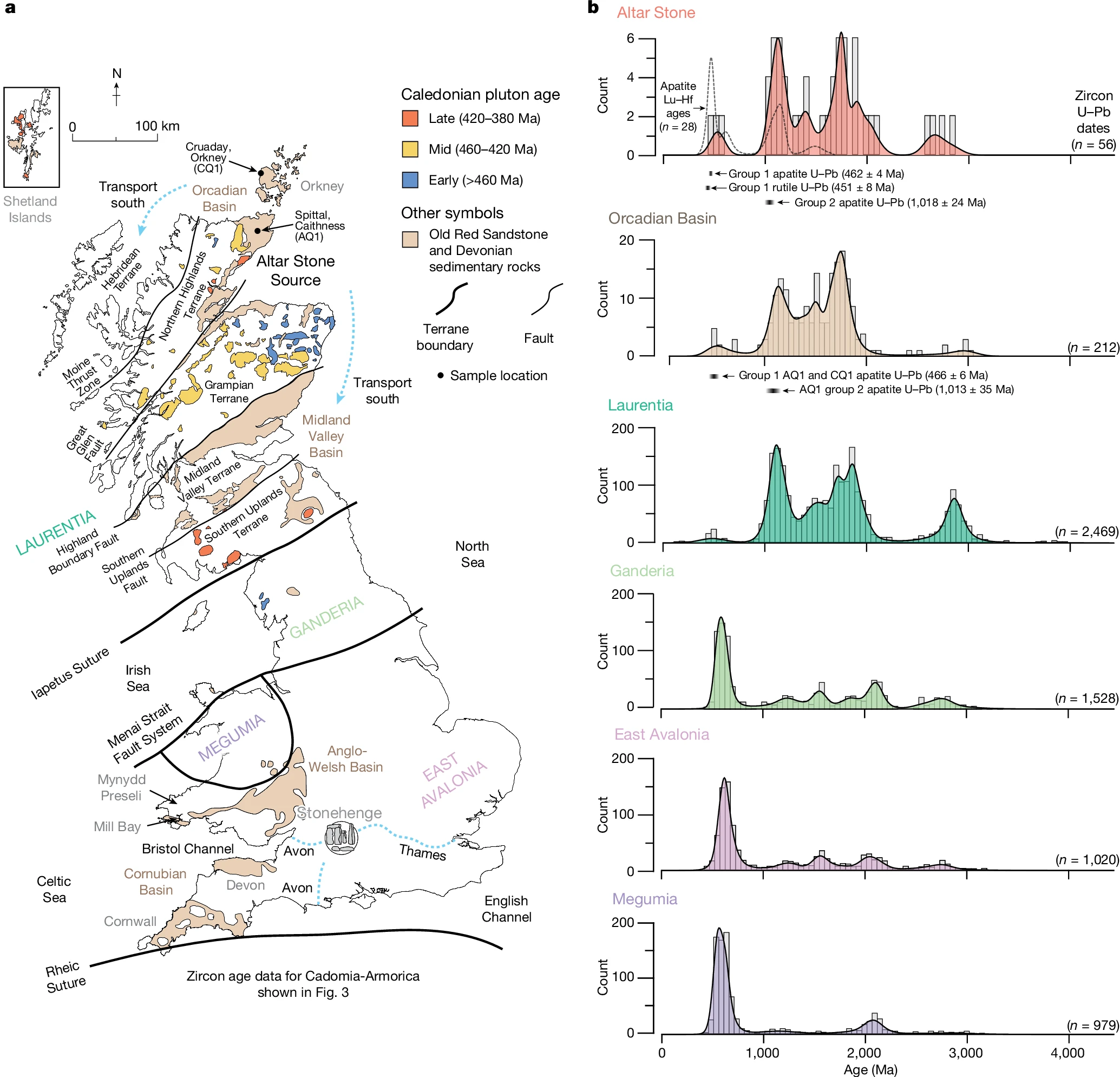
The origin of Stonehenge's Altar Stone must be in Laurentian terranes north of the Iapetus Suture (a major geological boundary separating northern Laurentian-derived rocks from southern Gondwanan ones) because the U-Pb ages in detrital minerals like zircon, apatite, and rutile show dominant Mesoproterozoic-Archaean peaks (e.g., ~1,047–1,790 Ma from Grenville, Labrador, and Gothian orogenies) with a mid-Ordovician overprint (~451–462 Ma from Grampian events), which are absent or mismatched south of this suture in regions like the Anglo-Welsh Basin or Dingle Peninsula. It cannot be from the Orkney Islands (Mainland Orkney) because petrographic and mineralogical analyses reveal mismatches, such as abundant detrital K-feldspar in Orkney Old Red Sandstone samples (versus very low in the Altar Stone), absent tosudite clay, and rare baryte cement (present in the Altar Stone). It cannot be from southwest Scotland (e.g., southwest Grampian Highlands or Midland Valley Basin) because, despite broad terrane similarities, statistical tests (Kolmogorov–Smirnov P < 0.05) show zircon U-Pb spectra mismatches (e.g., additional Devonian grains and fewer Archaean-Palaeoproterozoic ones), plus multi-proxy discrepancies in apatite trace elements, rutile ages, Pb isotopes, and petrography (e.g., more metamorphosed Dalradian sequences lacking the Altar Stone's unmetamorphosed, low-K-feldspar, baryte-cemented fabric). Therefore, it must be from the Orcadian Basin in northeast mainland Scotland, specifically areas like the Moray Firth to Caithness or John O'Groats, where the Mid-Devonian Old Red Sandstone matches all signatures as first-cycle detritus from Grampian sources.
|
Signature Type |
Altar Stone Characteristics |
Matching Source Characteristics |
Pinpointing Explanation |
|
Detrital Zircon U-Pb Ages |
Concordant ages span 498–2,812 Ma; major peaks at 1,047
Ma, 1,091 Ma, 1,577 Ma, 1,663 Ma, and 1,790 Ma (dominated by Mesoproterozoic
and Archaean components; no Carboniferous-Permian grains). |
Statistically indistinguishable (Kolmogorov–Smirnov test P
> 0.05) from Orcadian Basin Old Red Sandstone (ORS) samples (e.g., Spittal
Quarry, Caithness; similar Mesoproterozoic peaks tied to Grenville (1,095–980
Ma), Labrador (1,690–1,590 Ma), and Gothian (1,660–1,520 Ma) orogenies). |
Rules out Anglo-Welsh Basin (mid-Palaeozoic zircon maxima,
P < 0.05) and New Red Sandstone (lacks Archaean-Mesoproterozoic); matches
Laurentian terranes north of the Iapetus Suture, narrowing to Orcadian Basin
due to first-cycle detritus from Grampian Terrane. Southwestern Scotland
claim (e.g., Kokelaar) over-relies on broad terrane similarities but ignores
statistical mismatches (P < 0.05) with Midland Valley Basin
(central/southwest Scotland), which has additional Devonian zircons (~402 Ma)
and fewer Archaean-Palaeoproterozoic grains; no southwestern samples fit the
exact spectra. |
|
Apatite U-Pb Ages |
Two groups: Group 1 at 462 ± 4 Ma (mid-Ordovician, n=108);
Group 2 at 1,018 ± 24 Ma (Grenville, n=9). |
Orcadian Basin apatite: 473 ± 25 Ma and 466 ± 6 Ma
(Ordovician), 1,013 ± 35 Ma (Grenville); overlaps within analytical
uncertainty. |
Ordovician ages reflect Grampian magmatism (466–443 Ma
granitoids/gabbros); Grenville peak indicates Laurentian derivation; excludes
southern Britain (Neoproterozoic-early Palaeozoic dominance) and Dingle
Peninsula (ages <450 Ma). Southwestern sources lack the precise
mid-Ordovician overprint and Grenvillian balance seen in Orcadian samples,
further distinguishing from broader Grampian Terrane areas south of the Great
Glen Fault. |
|
Apatite Trace Elements |
61% felsic (La/Nd <0.6, (La + Ce + Pr)/ΣREE <0.5,
median Eu/Eu* = 0.59); 35% mafic-intermediate (La/Nd 0.5–1.5, (La + Ce +
Pr)/ΣREE 0.5–0.7, median Eu/Eu* = 0.62); 4% alkaline (La/Nd >1.5, (La + Ce
+ Pr)/ΣREE >0.8, median Eu/Eu* = 0.45). Chondrite-normalised REE patterns
show flat to negative gradients; mafic grains REE-enriched (up to 1.25 wt%
ΣREEs). |
Aligns with Grampian Terrane granitoids (felsic dominance)
and Orcadian samples (similar REE profiles and principal component analysis
discriminants like Nd and La). |
Felsic-mafic mix indicates direct input from Grampian
igneous sources; supports northeast Scottish provenance over Anglo-Welsh
(different REE signatures and metamorphic overprints). Southwestern/central
Scotland sediments show varied REE profiles due to different metamorphic
histories and source mixing, not matching the Altar Stone's specific
felsic-mafic ratio or REE enrichment. |
|
Apatite Lu-Hf Ages |
Ages at 1,496 Ma and 1,151 Ma (Laurentian); Group 1 at 470
± 29 Ma (Ordovician). |
Matches Orcadian Basin (e.g., 470 Ma overprint from
Grampian events). |
Reinforces Laurentian crust sourcing with mid-Ordovician
metamorphic-magmatic overprint unique to regions north of Iapetus Suture.
Southwestern claims ignore this overprint's specificity to northeastern
basins, where Grampian events align more closely. |
|
Rutile U-Pb Ages |
Group 1 at 451 ± 8 Ma (mid-Ordovician, n=83); Group 2
Proterozoic (591–1,724 Ma, peak at 1,607 Ma, overlapping Labrador/Pinwarian
orogenies). |
Consistent with Laurentian orogenies in Orcadian Basin
(Ordovician overprint from Grampian; Proterozoic peaks match basement
terranes). |
Ordovician group indicates Grampian influence; Proterozoic
peak rules out southern Gondwanan terranes (Neoproterozoic rutile dominance);
supports first-cycle detritus from northeast Scotland. Rutile signatures in
southwestern Scotland include more variable Proterozoic peaks due to
Dalradian metamorphism, not fitting the exact Labrador/Pinwarian dominance. |
|
Pb Isotopes (207Pb/206Pb) |
Apatite: 0.8603 ± 0.0033; Rutile: 0.8564 ± 0.0014 (initial
ratios). |
Matches Stacey-Kramers continental crust evolution model
at 465 Ma (0.8601). |
Consistent with evolved Laurentian crust north of Iapetus
Suture; excludes less radiogenic southern British sources. Southwestern
sources show similar but not identical ratios, diluted by local crustal
variations not present in Orcadian Basin. |
|
Mineral Composition & Petrography |
Micaceous sandstone with baryte cement, calcite, clay
minerals (including tosudite); very low K-feldspar; heavy mineral bands
(zircon, rutile, apatite) with igneous textures (oscillatory zoning, no
metamorphic overgrowths); absent marine fossils. |
Orcadian Basin (non-Orkney): Low K-feldspar, presence of
baryte and tosudite in some sequences; first-cycle magmatic detritus. Differs
from Mainland Orkney ORS (abundant detrital K-feldspar in all samples, absent
tosudite, baryte rare in only 2 samples). |
Rules out Mainland Orkney (petrographic mismatches via
X-ray diffraction, Raman, SEM-EDS); indicates continental fluvial-lacustrine
deposition in other Orcadian areas (e.g., Moray Firth to John O'Groats);
supports Mid-Devonian ORS with Grampian-derived sediments. Southwestern
Grampian/Dalradian sequences are more metamorphosed (e.g., poly-deformed with
garnets), lacking the unmetamorphosed, low-K-feldspar, baryte-cemented
fabric; no exact petrographic match exists there. |

No comments:
Post a Comment
Comments welcome on fresh posts - you just need a Google account to do so.