The Anomalous 464 Ma Zircon Grain in the Stonehenge Detrital Study
In Clarke & Kirkland’s 2025 paper (Communications Earth & Environment), one grain stands out amid 550 zircon analyses (401 concordant after ±10% discordance filter): a single concordant U–Pb age of 464 ± 16 Ma (2σ) from sample SH3 (River Wylye catchment). This Darriwilian age precisely matches the Fishguard Volcanic Group of the Mynydd Preseli, Wales—the accepted source of Stonehenge’s bluestones (Bevins et al., 2016).
The grain appears in the kernel-density plot (Fig. 2) as an isolated component within the minor Phanerozoic tail (~8% of the dataset). No cluster of similar ages exists; the spectrum is overwhelmingly dominated by Mesoproterozoic–Palaeoproterozoic Laurentian peaks (ca. 1090, 1690, 1740 Ma). Grain morphology (rounded, abraded, oscillatory/sector zoning, inherited cores) is consistent with multi-cycle sedimentary recycling rather than first-cycle glacial input.
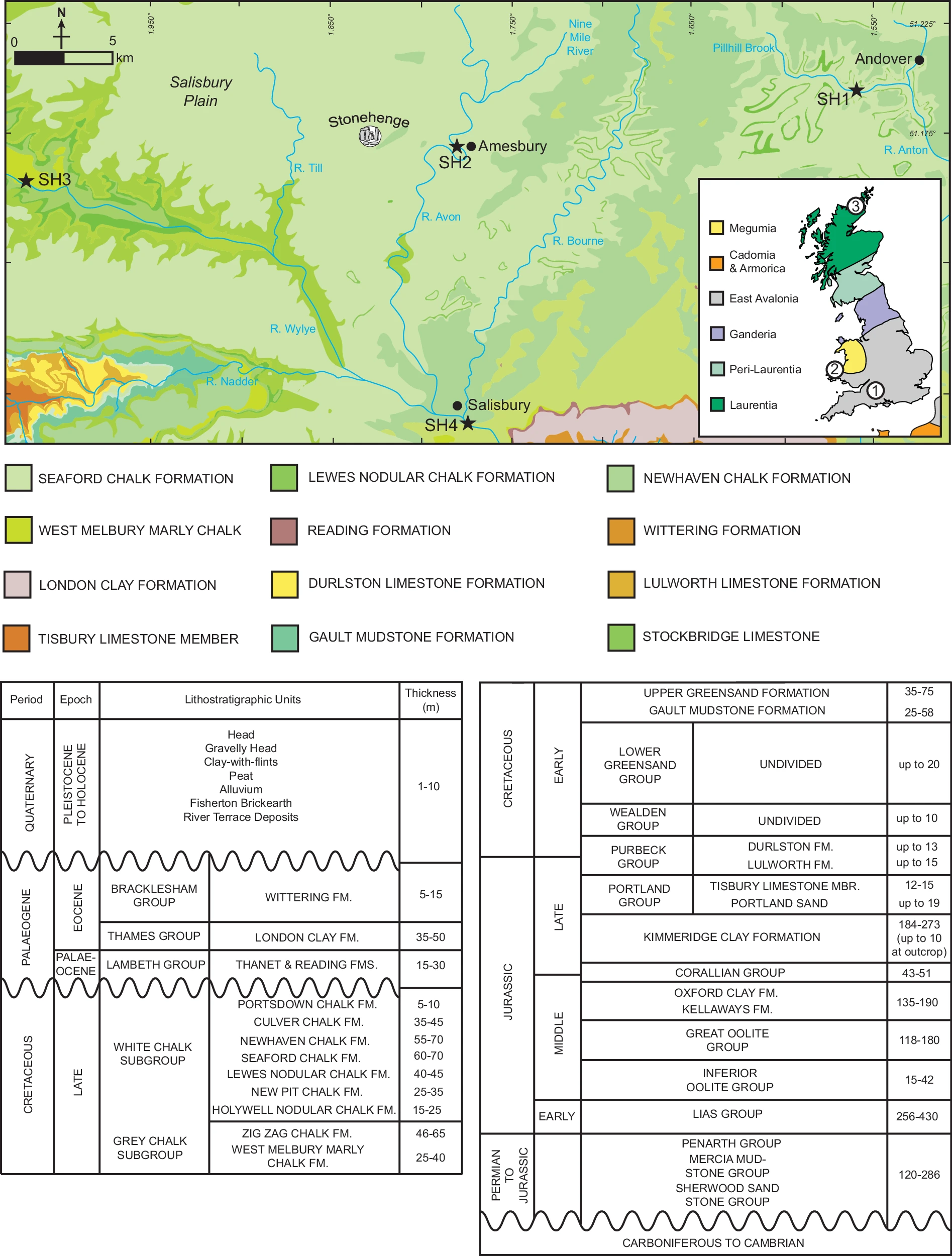
Peer-review scrutiny The grain was rigorously questioned, particularly by Reviewer #1. In the initial round, it was called the paper’s “most interesting finding” and “a small nail in the coffin” for the glacial hypothesis, but its rarity (1/550) was noted. The reviewer mistakenly attributed the grain to SH1 (east/north-east of Stonehenge, near Andover) rather than the correct SH3 location (south-west of Stonehenge in the Wylye valley). Despite this misidentification of the sample, Reviewer #1’s broader point still stands: the grain’s catchment is not aligned with a direct ice-flow path from Mynydd Preseli to Stonehenge, weakening any glacial interpretation. In the revision round, the reviewer sharpened the critique: the abstract and conclusions could not “rule out” glacial transport if even one matching grain existed, warning it would provide “low hanging fruit for anyone wanting to dismiss the findings.” They demanded a “plausible argument” for its non-glacial origin, stronger emphasis that a genuine glacial signal from transporting 80+ multi-tonne erratics would produce a “much stronger 464 Ma signature,” and clarification of catchment context relative to ice-flow vectors.
Other reviewers reinforced this indirectly—Reviewer #2 highlighted the complete absence of corresponding old apatite as “extremely strong evidence against glacial transport,” as first-cycle delivery would not decouple zircon and apatite so cleanly.
Interpretation and rebuttal The authors addressed these points comprehensively. The grain is attributed to multi-cycle recycling from Palaeogene units (e.g., Thanet Formation), where sporadic Darriwilian ages occur (Stevens & Baykal, 2021). Darriwilian zircons are not unique to Preseli; they appear in recycled Cenozoic strata across southern Britain. Its isolation in a large-n dataset is statistically expected background noise given zircon’s durability and hydraulic biases. Critically, glacial transport of multiple bluestone erratics (or associated outwash) would leave a detectable, recurring population in the fine fraction—especially on zircon-poor Chalk—alongside coarse lithic clasts, other Welsh-affinity ages (Cadomian, Neoproterozoic arc), and first-cycle textures. None are present. The uniform Laurentian fingerprint across catchments, well-rounded mature grains, and lack of proximal crystalline sources further rule out significant glacial input.
Why it is not a “speck of hope” for glacial transport
The grain’s rarity, non-uniqueness, catchment position, and inconsistency with expected glacial signatures (abundance, accompanying indicators) make it fully compatible with the paper’s conclusion: Salisbury Plain’s detrital record reflects Palaeogene recycling and Alpine-related remobilisation, not Pleistocene ice incursion. The rigorous peer-review exchange ensured this interpretation is robust and pre-empts common criticisms.

No comments:
Post a Comment
Comments welcome on fresh posts - you just need a Google account to do so.