http://www.walesonline.co.uk/news/wales-news/origin-stonehenges-blue-stones-pinpointed-6317230
New research has established that stones from Wales were definitely used in the building of one of the world’s best known prehistoric sites at Stonehenge – but that they came from a hill a mile away from the place previously assumed to be their source.
A team of three geologists including Dr Richard Bevins, Keeper of Natural Sciences at the National Museum of Wales in Cardiff, have identified a hill called Carn Goedog, about three miles from Crymrch in the Preseli Hills of Pembrokeshire, as the site from which 11 stones known as spotted dolerites were somehow transported to Stonehenge in Wiltshire.
Together with his colleagues Dr Rob Ixer of University College, London and Professor Nick Pearce of Aberystwyth, Dr Bevins will next year have a peer-reviewed paper published by the prestigious Journal of Archaeological Science.
Tuesday, 19 November 2013

Monday, 18 November 2013
Building Stonehenge in a time of Climate Change

(Click here for a full sized print (3000 pixels wide, suitable for printing).
...The upper part of the poster shows three ice core records. The top record is actually a composite reconstruction of six Greenland ice core records4. The middle chart is the most recent portion of the Vostok Antarctic ice core record, the entire Vostok 400,000 year record is show in the upper left of the poster....The bottom large chart is the actual temperature, calculated from a single central Greenland ice core.
Just below the Central Greenland ice core record the “Bond” cooling events over this 18,000 year period are noted7. The Bond cooling events average around 1,500 years apart and some are more dramatic than others. The 8.2, 5.9 and 4.2 kiloyear events were major events8,9, with dramatic cooling and they were huge disruptions for civilizations around the world. Others, like the 2.8 kiloyear event in the Iron Age were hardly noticed....
5.9 Kiloyear Bond Event
About 5,900 years ago the Sahara became a desert (The 5.9 kiloyear event or Bond event 4) and this very severe drought also ended the Ubaid empire and caused a huge migration of people from the Sahara region in search of food and water. The people migrated to river valleys, such as the Nile Valley in Egypt, in order to be close to water. Claussen, et al., 199936 has suggested that this drought was caused by a severe cooling event that occurred at the same time. The Sahara never recovers from this event. But, since the drought forces people into river valleys, larger cities are built and societies become more complex.
Following the end of the 5.9 kiloyear event and the end of the Holocene Thermal Optimum, around 4,500 years ago the earliest Egyptian pyramids are built, Stonehenge is constructed in present day England and the first large cities appear in India. The earliest Mayan cities appear a little over 600 years later around 3,900 years ago.
4.2 Kiloyear Bond Event
The 4.2 kiloyear event was a very cool period in the Arctic (the Bond Event 3) and it caused a very severe drought in the Middle East. This period caused a sudden collapse of the Egyptian government, famines and social disorder. Similar disruptions occurred in the Akkadian Empire, the Indus Valley and in China.
Around 3,300 years ago, the great Bronze Age civilizations in the Middle East collapsed. These included the Mycenaean’s, the Hittites and the Egyptian New Kingdom. This sudden collapse was probably caused by another extended and severe drought. The onset of this drought coincides with a sudden and extended cooling period in the Central Greenland ice core data. In general, most large scale droughts in the last 18,000 years appear to be associated with cooling in the Arctic. This marks the end of the Minoan Warm Period.
Thursday, 14 November 2013
Stoneholes 17-20 - first detailed photographs
https://www.dropbox.com/sh/vh7hhugyb5bp0ys/0wJttnAby9 is the public depository of the detailed photographs of the Stonehenge Stonehole parchmarks I took this summer and some of the adjacent ones.


The photographs are taken from a stepladder to give as near vertical aerial shots as possible. Each hole is marked by a numbered or lettered card (not always clear due to glare).
More on the Parchmarks at Stonehenge
Wednesday, 13 November 2013
Stonehenge Winter Solstice 2013

Managed Open Access
The celebration of the Winter Solstice at Stonehenge will take place at sunrise
on Saturday 21 December 2013 (approximately 08:09 hrs).
English Heritage is pleased to be offering ‘Managed Open Access’ for those
who wish to celebrate the Winter Solstice peacefully
Visitors will be allowed into the Monument when it is considered sufficiently
light to ensure safe access. Entry will be available from approximately 07:30
hrs until 09:00 hrs when visitors will be asked to vacate the site. All vehicles
must vacate the area by 09.30.
Access might not be possible if the ground conditions are poor or if it is felt
that access might result ¡n severe damage to the Monument.
Toilets are available at Stonehenge for the duration of the access although
these facilities will not be available prior to access commencing.
Public car parking will be made available on Byway 12, the old Visitor Centre
Car Park and along the A344.
Disabled parking will be in the old Visitor Centre Car Park, and will require a
special permit.
Connected:
New theory of a Winter Solstice Sunrise Alignment - Stonehenge and the Winter Solstice leaflet (ISBN 9780957093010)
(Background on the Winter Solstice Sunrise Alignment theory is here)
Tuesday, 12 November 2013
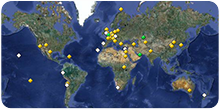
Astronomical Heritage Finder from UNESCO
Friday, 8 November 2013
Thursday, 7 November 2013
All Cannings Long Barrow
A lot is happening at Stonehenge at the moment as we prepare for the opening of the new visitor centre, wait and see!
On a personal note I'm neglecting the blog as I am in the process of building a working Long Barrow at All Cannings.
This is going to a be a magnificent interpretation of a traditional Long Barrow in which niches for the deposition of cremated remains in urns will be available to the public.
There is a Facebook group - https://www.facebook.com/groups/461357813920636/ - and I will try to update here on the progress as well.

On a personal note I'm neglecting the blog as I am in the process of building a working Long Barrow at All Cannings.
This is going to a be a magnificent interpretation of a traditional Long Barrow in which niches for the deposition of cremated remains in urns will be available to the public.
There is a Facebook group - https://www.facebook.com/groups/461357813920636/ - and I will try to update here on the progress as well.
Ten tons of sarsens being laid out ready for the Long Barrow.
Subscribe to:
Posts (Atom)