Wednesday, 12 February 2025

The Archive Excavation of the Altar Stone

In 1958 Richard Atkinson excavated around the Altar Stone at Stonehenge. Photographs of the excavation held in the Historic England Archive were examined by Tim Daw on 28th January 2025 with the greatly appreciated assistance of Simon Banton. Many of the photos were not recorded as being of the Altar Stone and were found only by careful study of entire archive. The following illustrate previously unrecorded features of the Altar Stone. The photos are labelled with the Historic England archive number, and present archive description, and the direction of the shot is illustrated on the annotated plan below.

They have been digitised by Historic England for Tim Daw. They are all copyright Historic England and reproduced here under Permission No: 10238. Digital copies have been available on the Historic England archive website and a version of this blog post using them is at https://www.sarsen.org/2025/02/the-archive-excavation-of-altar-stone_24.html.
The photos here have been reduced in size or are the web versions to comply with the reproduction licence. Click them to embiggen to the size allowed, the originals are larger and are available on the updated version https://www.sarsen.org/2025/02/the-archive-excavation-of-altar-stone_24.html..   

He also lifted Stone 55B to examine the underside of 55B – the very brief description of the excavation is in his book “Stonehenge, 1979 revised edition” and does not include a description of the lifting of 55b. The photos in the archive seem to be the only record revealing its finely worked surface. 


The photo locations based on Atkinson’s plan in Cleal et al, rotated for convenience.


P51196 (1958 Excavation Near Alter Stone (St.80))
The excavated North East face showing the break and loose fragments.


P51908 (1958 Excavation Of Altar Stone,Stone 80) Looking South West at excavated Altar Stone. P51909 is very similar but not digitised.


P50361 (Excavated Unidentified Stone) The South East end from the North East 


P50359 (Excavated Unidentified Stone) Vertical of South East end


P50102 (1958 Excavation Of Altar Stone. S.E. End, View S.W.) South East end from the South West showing the graffito noted as “IB” by Atkinson on his plan. Stone 55b is to the left.

Simon Banton notes that a similar engraving, “FB”, is on Stone 62. The crossed I or F is also similar to the symbol on the WREN graffito on Stone 52.


Photos from Stones of Stonehenge - Simon Banton


P50002 (Unidentified Stone, Carved Initials "Id”) South East end from South showing “IB” engraving


P50005 (2 Unidentified Stones In Excavation) The South West side of the Altar Stone under 55b taken at night for lighting purposes. The stone extends from the break in the foreground to the baulk under 156. 


P50009  (2 Unidentified Stones In Excavation) is a similar photo revealing the fine working of the stone. The scratches at the top of the stone are similar to the ones on the middle section, see below, but from these photos it is uncertain what they are.


P51808 (1958 Excavation Of Alter Stone, Stone 80) Altar Stone – The middle section of the top surface between 55b, top, and 156, bottom,


P50107 (Surface Of Altar Stone From North East) Middle Section of South West side of the Altar Stone showing engraved lines, taken from South West . 


P50106 is similar. These scratches have obvious similarity to other neolithic stone markings. The vertical line is thought to be a quartz vein in the stone.


P51811 (1958 Excavation Of Alter Stone, Stone 80) Altar Stone North West end from above, standing on 156.


P51805 (1958 Excavation Of Alter Stone,Stone 80) North West end of the Altar Stone under 156.


P51874 (1958 Lifting Of Stone 55B) – The best photos of the top of the Altar Stone, it doesn’t seem to have been photographed when 55b was lifted.


P51873 (1958 Lifting Of Stone 55B) looking South East with the Altar Stone exposed. The methods used for the lifting of the stone might be thought not to follow present day best practice.


P50371 (Atkinson Looking At Unidentified Stone With Cable) Richard Atkinson underneath 55b looking South West, he is lying against 156 and 55a is on the ground to the left protected by the wooden post.  

Click them to embiggen to the size allowed, the originals are larger and are available on the updated version https://www.sarsen.org/2025/02/the-archive-excavation-of-altar-stone_24.html.    

Thursday, 6 February 2025

The source of the quartz at Newgrange

I gather that misinformation about the stones of Newgrange is being strewn across the interweb.

So quickly here is the present state of knowledge:

"Newgrange, a Neolithic monument built around 3200 BCE,in Ireland's Boyne Valley, is renowned for its intricate architecture and the variety of stones used in its construction.  The stones that make up Newgrange were sourced from diverse locations, reflecting the builders' ability to transport and utilize materials from across the region.

The Newgrange mound is primarily composed of thousands of water-rolled stones gathered from the nearby River Boyne. These stones, weighing approximately 200,000 tonnes, form the bulk of the cairn. The inner passageway and outer kerbstones are made of greywacke, a type of stone that was likely collected from the rocky beach at Clogherhead, County Louth, about 20 km to the northeast.

The exterior of Newgrange features a striking array of decorative stones, including:

White Quartz Cobbles: These were transported from the Wicklow Mountains, approximately 50 km to the south. The quartz stones were used to create a facade that has been reconstructed in modern times.

Dark Speckled Granodiorite Cobbles: Originating from the Mourne Mountains, about 50 km to the north, these stones add a distinctive element to the monument's design.

Dark Gabbro Cobbles: Sourced from the Cooley Mountains, these stones contribute to the complex's visual appeal.

Inside the chambers, granite basins were used, which were brought from the Mournes. These basins are significant not only for their material but also for their role in the structure's function, possibly as repositories for the remains of the dead." 

From: https://www.perplexity.ai/search/write-a-blog-post-with-referen-53n66lYrS06qukqxIX0kqQ#0


Click to enlarge - from: Notes on Some Non-Local Cobbles at the Entrances to the Passage-Graves at Newgrange and Knowth, County Meath Frank Mitchell The Journal of the Royal Society of Antiquaries of Ireland, Vol. 122 (1992), pp. 128-145 (18 pages) https://www.jstor.org/stable/25509025 


And supporting this there is, for the academics with access, the magisterial: 

Meighan, I.G., Simpston, D.D.A., Hartwell, B.N., Fallick, A.E. and Kennan, P.S. (2003) Sourcing the quartz at Newgrange, Bru na Boinne, Ireland. In: Burenhult, G. and Westergaard, S. (eds.) Stones and Bones: Formal Disposal of the Dead in Atlantic Europe During the Mesolithic-Neolithic Interface 6000-3000 BC: Archaeological Conference in Honour of the Late Professor Michael J. O'Kelly. Series: BAR international series (1201). Archaeopress: Oxford, UK, pp. 247-251. ISBN 9781841715667

There is no evidence to show that any quartz stones were brought onto the site during the reconstruction. O'Kelly excavated the "numerous angular fragments" he used from in front of the monument. Whether his reconstruction is in any way accurate is another matter. 

O’Kelly, M.J. (1979) ‘The restoration of Newgrange’, Antiquity, 53(209), pp. 205–210. doi:10.1017/S0003598X00042538.


UPDATE:

Academic Sources on the Provenance of White Quartz at NewGrange

Introduction

NewGrange, a Neolithic passage tomb in County Meath, Ireland, constructed around 3200 BC, is renowned for its architectural grandeur and cultural significance. One of its most distinctive features is the facade, composed of white quartz cobblestones that create a striking visual effect. The question of where this quartz was sourced has intrigued archaeologists and geologists, as it sheds light on the logistical capabilities, trade networks, and symbolic intentions of the Neolithic builders. This article compiles a comprehensive list of academic sources that a researcher should consult to understand the provenance of the white quartz at NewGrange. These sources include primary research papers, excavation reports, and scholarly books, each verified for relevance and academic rigor.

The Importance of Quartz Provenance

The white quartz at NewGrange is not only a structural element but also a cultural artifact. Its reflective quality likely held symbolic meaning, possibly related to light, purity, or spiritual significance, given the monument’s alignment with the winter solstice. Determining its source reveals the extent of the builders’ efforts to procure specific materials, suggesting advanced organizational skills and possibly long-distance trade or transport networks. The consensus among researchers is that the quartz was sourced from the Wicklow Mountains, approximately 70 miles south of NewGrange, a conclusion supported by geological and archaeological evidence.

Key Academic Sources

1. Meighan et al. (2003): Sourcing the Quartz at NewGrange

  • Citation: Meighan, I.G., Simpson, D.D.A., Hartwell, B.N., Fallick, A.E., and Kennan, P.S. (2003). Sourcing the Quartz at Newgrange, Bru na Boinne, Ireland. In G. Burenhult and S. Westergaard (eds.), Stones and Bones: Formal Disposal of the Dead in Atlantic Europe During the Mesolithic-Neolithic Interface 6000-3000 BC. BAR International Series 1201. Archaeopress: Oxford, UK, pp. 247-251.
  • Description: This seminal paper directly addresses the provenance of the white quartz used in NewGrange’s facade. Using isotopic and geological analysis, the authors trace the quartz to the Wicklow Mountains, specifically noting its compatibility with quartz veins near Glendalough. The study is a cornerstone for understanding the material origins of the monument.
  • Relevance: As a primary research paper, it provides the most detailed scientific evidence for the quartz’s source, making it essential for any study on NewGrange’s construction materials.
  • Access: Available through academic libraries or publishers like Archaeopress.

2. Meighan et al. (2002): Sourcing of Granitic Cobbles

  • Citation: Meighan, I., Simpson, D.D.A., and Hartwell, B. (2002). Newgrange – Sourcing of its granitic cobbles. Archaeology Ireland, 16(4), 32-35.
  • Description: While primarily focused on the granitic cobbles used in NewGrange’s facade, this paper complements the 2003 study by discussing the broader context of material sourcing. It includes references to the quartz, reinforcing the Wicklow Mountains as a key source for multiple materials.
  • Relevance: This paper provides additional geological insights into the sourcing of NewGrange’s materials, offering a holistic view of the monument’s construction.
  • Access: Accessible via JSTOR or Archaeology Ireland archives.

3. Hensey & Shee Twohig (2017): Facing the Cairn

  • Citation: Hensey, R., and Shee Twohig, E. (2017). Facing the cairn at Newgrange, Co. Meath. Journal of Irish Archaeology, 26, 1-20.
  • Description: This paper reviews the archaeological evidence for the quartz-and-granite-faced revetment at NewGrange, addressing controversies surrounding its reconstruction by Michael J. O’Kelly. It draws on excavation archives and correspondence to argue that the quartz was likely used for maximum visual impact, supporting the Wicklow Mountains origin. The authors also compare NewGrange to other European passage tombs with similar revetments.
  • Relevance: It provides a critical analysis of the quartz’s role and the decision-making process behind its use, making it crucial for understanding both the material and its cultural context.
  • Access: Available through JSTOR or academic libraries.

4. Tilley (2008): Landscape Phenomenology

  • Citation: Tilley, C. (2008). Body and Image: Explorations in Landscape Phenomenology. Left Coast Press, Walnut Creek, CA, p. 160.
  • Description: This book explores the phenomenological aspects of Neolithic monuments, including NewGrange. It discusses the materials used in the facade, noting the quartz’s origin in the Wicklow Mountains and its symbolic significance in the landscape.
  • Relevance: While not a primary source, it offers a theoretical perspective on why specific materials like quartz were chosen, complementing the geological data.
  • Access: Available through university libraries or for purchase from Routledge.

5. Shee Twohig (1981): Megalithic Art

  • Citation: Shee Twohig, E. (1981). The Megalithic Art of Western Europe. Clarendon Press, Oxford.
  • Description: This comprehensive study examines megalithic art and construction across Western Europe, including NewGrange. It discusses the use of quartz in passage tombs, providing context for its symbolic and structural roles.
  • Relevance: The book situates NewGrange within a broader European context, offering insights into why quartz was valued in Neolithic architecture.
  • Access: Available through Oxford University Press or academic libraries.

6. O’Kelly (1982): Excavation Report

  • Citation: O’Kelly, M.J. (1982). Newgrange: Archaeology, Art and Legend. Thames and Hudson, London.
  • Description: This is the definitive excavation report for NewGrange, authored by the lead archaeologist, Michael J. O’Kelly. It details the discovery of large quantities of quartz around the monument’s base, the decision to reconstruct the facade as a vertical wall, and initial observations about the materials’ origins.
  • Relevance: As the primary source for the excavation, it is indispensable for understanding the archaeological context of the quartz and the debates surrounding its reconstruction.
  • Access: Widely available through libraries or Thames & Hudson.

Summary Table

Source Authors Year Publication Focus Key Contribution
Meighan et al. Meighan, Simpson, Hartwell, Fallick, Kennan 2003 Stones and Bones (BAR International Series) Quartz sourcing Geological evidence linking quartz to Wicklow Mountains
Meighan et al. Meighan, Simpson, Hartwell 2002 Archaeology Ireland Granitic cobbles, quartz context Broader material sourcing insights
Hensey & Shee Twohig Hensey, Shee Twohig 2017 Journal of Irish Archaeology Quartz revetment Archaeological evidence and reconstruction debate
Tilley Tilley 2008 Body and Image Landscape phenomenology Symbolic role of quartz in Neolithic context
Shee Twohig Shee Twohig 1981 Megalithic Art of Western Europe Megalithic art and construction Contextualizes quartz use in European passage tombs
O’Kelly O’Kelly 1982 Newgrange: Archaeology, Art and Legend Excavation report Primary data on quartz discovery and facade reconstruction

The Wicklow Mountains Connection

The consensus among these sources is that the white quartz was sourced from the Wicklow Mountains, approximately 70 miles south of NewGrange. Meighan et al. (2003) provide the most direct evidence, using isotopic and petrographic analysis to match the quartz to deposits near Glendalough. The Wicklow Mountains are geologically rich in quartz veins, making them a plausible source. O’Kelly (1982) notes that the quartz was found scattered around the monument’s base, suggesting it was transported and deliberately placed. Hensey and Shee Twohig (2017) argue that the effort to procure quartz from such a distance indicates its importance, likely for its reflective properties and symbolic value.

Logistical Implications

Transporting thousands of quartz cobblestones over 70 miles would have been a significant undertaking. Researchers suggest the stones were quarried in the Wicklow Mountains, possibly loaded onto barges, and transported via rivers to the Irish Sea, then north to the River Boyne near NewGrange. This process, described in sources like Meighan et al. (2002), highlights the Neolithic builders’ advanced logistical capabilities and the cultural significance of the monument.

Controversies and Debates

The reconstruction of NewGrange’s facade, led by O’Kelly in the 1960s and 1970s, has sparked debate. Critics, as noted in Hensey and Shee Twohig (2017), argue that the vertical quartz wall, supported by a modern concrete structure, may not reflect the original Neolithic design. Some suggest the quartz was arranged differently, perhaps as a sloping layer or scattered decoratively. Despite this, the Wicklow Mountains origin of the quartz is less contentious, supported by consistent geological evidence across sources.

Symbolic Significance

The choice of white quartz was likely deliberate, as discussed in Tilley (2008) and Shee Twohig (1981). Its reflective quality would have made NewGrange stand out in the landscape, especially during the winter solstice when sunlight enters the chamber. This aligns with the monument’s astronomical alignment, suggesting quartz was chosen for both aesthetic and spiritual reasons.

Gaps and Future Research

While the Wicklow Mountains origin is well-supported, few studies post-2017 have revisited the quartz’s provenance. Recent research, as searched up to 2025, focuses more on NewGrange’s cultural and genetic significance rather than material sourcing. Future studies could employ advanced geochemical techniques to further confirm the quartz’s origin or explore alternative sources.

Conclusion

The white quartz at NewGrange, likely sourced from the Wicklow Mountains, is a testament to the Neolithic builders’ ingenuity and cultural priorities. The academic sources listed—ranging from primary geological studies to archaeological analyses—provide a robust foundation for understanding this aspect of the monument. Researchers should consult these works to gain a comprehensive view of the quartz’s provenance, its logistical implications, and its role in NewGrange’s enduring legacy.

Sunday, 2 February 2025

The Combined Viewshed of the Tor and Cuckoo Stones.

 The new paper on the Tor and Cuckoo Stone* posits that: "The intervisibility of the two stones is likely to have been an essential feature of their locations, near the boundaries of their respective overlapping viewsheds,... the DTM indicates that a transect drawn between the two stones  passes close to the apex of a meander in the River Avon at a point where it is approximately equidistant from each stone and potentially intervisible, both from and towards both stones.

The paper has shows their individual viewsheds but not them combined. Simply overlaying the two figures and tweaking the colours gives the combined viewshed. 


Click to enlarge - all rights remain with the original paper


The mustard colour shows where both stones would be visible from, I thought they might have acted as pillars visible either side from the route through the landscape but that doesn't seem to be. But the apex of the river meander could be important. More to ponder on.

*HARDING, P. et al. (2025) ‘Earliest Movement of Sarsen Into the Stonehenge Landscape: New Insights from Geochemical and Visibility Analysis of the Cuckoo Stone and Tor Stone’, Proceedings of the Prehistoric Society, pp. 1–23. doi:10.1017/ppr.2024.13.

Friday, 31 January 2025

None of the Stonehenge Stones are Local

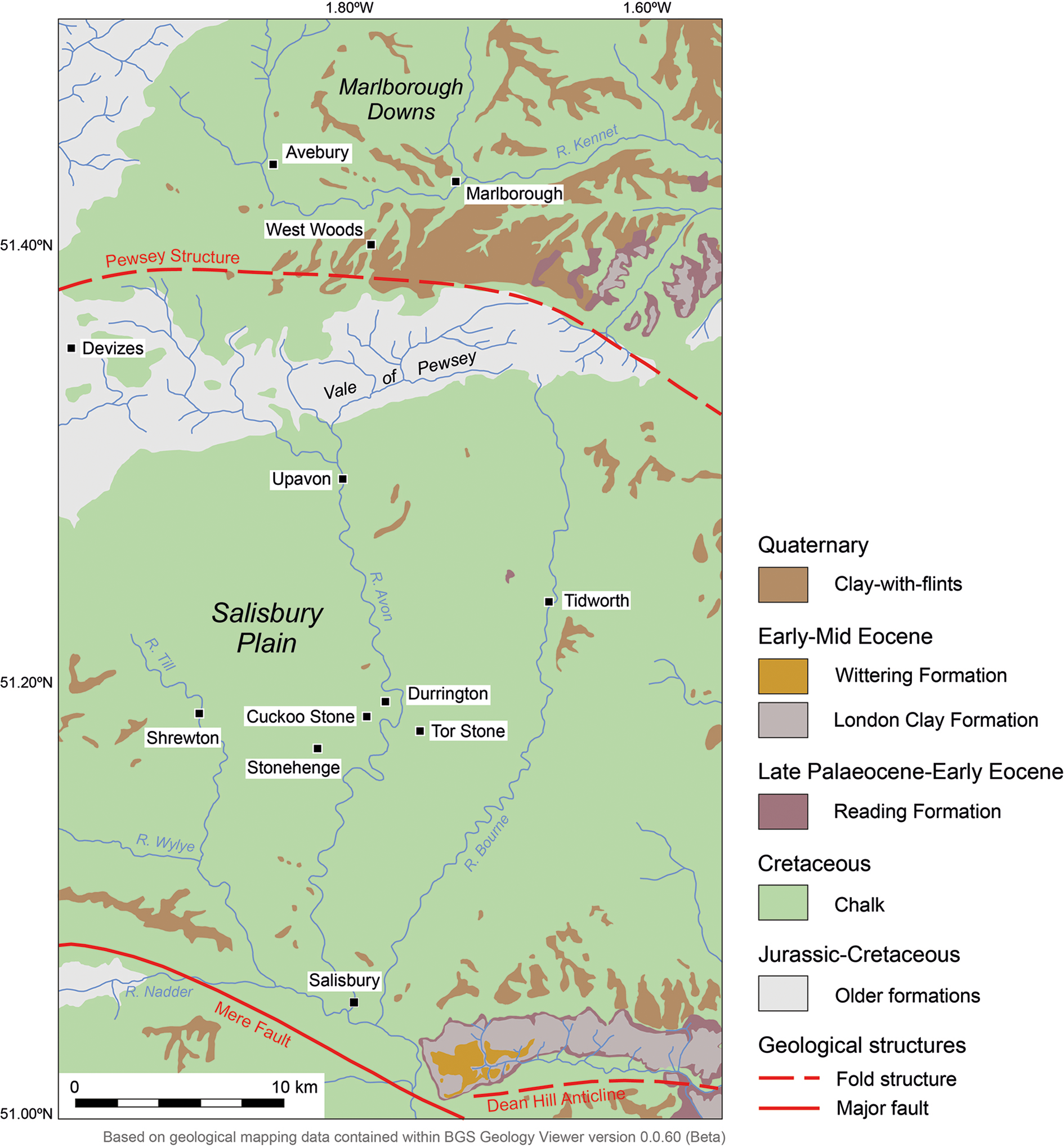
The new paper on the Cuckoo and Tor stones (*) posits that they are not local to Salisbury Plain and were brought from West Woods. It goes further and claims that no large numbers of large sarsens with a chemistry the same as those at West Woods are likely to have originated near Stonehenge.

This is surprising. They debate the obvious question here:

https://www.cambridge.org/core/journals/proceedings-of-the-prehistoric-society/article/earliest-movement-of-sarsen-into-the-stonehenge-landscape-new-insights-from-geochemical-and-visibility-analysis-of-the-cuckoo-stone-and-tor-stone/C7C6D363A6E59D0BBF5C3158077ABB24#s4

Geological implications

Our inference that the Cuckoo Stone and Tor Stone probably originated in the West Woods area directly challenges the suggestion made by Richards (Reference Richards and Parker2020) that both stones were either already situated at, or close to, their source locations when they were monumentalised. There is, however, a potential counter argument that would support Richards’ view: rather than the two stones being moved from West Woods, could it be that large sarsen boulders with a geochemistry similar to those at West Woods were already present in the Stonehenge landscape near the sites where the two stones were raised?

Their answer is no and I find their reasoning compelling.


* HARDING, P. et al. (2025) ‘Earliest Movement of Sarsen Into the Stonehenge Landscape: New Insights from Geochemical and Visibility Analysis of the Cuckoo Stone and Tor Stone’, Proceedings of the Prehistoric Society, pp. 1–23. doi:10.1017/ppr.2024.13.

Thursday, 30 January 2025

Earliest Movement of Sarsen Into the Stonehenge Landscape:

Earliest Movement of Sarsen Into the Stonehenge Landscape: New Insights from Geochemical and Visibility Analysis of the Cuckoo Stone and Tor Stone


Abstract: This paper presents the results of new research on two sarsen stones, known as the Cuckoo Stone and Tor Stone, both former standing stones that lie on opposite banks of the River Avon and straddle the eastern border of the Stonehenge and Avebury World Heritage Site. Geochemical analysis indicates that both stones were probably transported to their present site from West Woods on the Marlborough Downs in north Wiltshire, a source that likely also supplied the large sarsen monoliths at Stonehenge. The paper examines the geological conditions necessary for the formation of sarsen across the site of the present-day Salisbury Plain to address the apparent absence of natural sarsen in the area. The results are integrated with those of archaeological fieldwork from nearby contemporaneous sites to suggest that the Cuckoo Stone and Tor Stone were probably introduced into the Stonehenge landscape in the early part of the Late Neolithic period, ie, contemporary with Phase 1 of Stonehenge and some 400–500 years before the construction of the principal sarsen settings at the monument. Visibility analysis indicates that the two stones were probably intervisible and likely to have formed part of a planned landscape and were positioned to create a formal portal to the Stonehenge area on either bank of the River Avon.


HARDING, P. et al. (2025) ‘Earliest Movement of Sarsen Into the Stonehenge Landscape: New Insights from Geochemical and Visibility Analysis of the Cuckoo Stone and Tor Stone’, Proceedings of the Prehistoric Society, pp. 1–23. doi:10.1017/ppr.2024.13.


Wednesday, 22 January 2025

Stonehenge and its Altar Stone: the significance of distant stone sources

The long awaited MPP article on Stonehenge has arrived:


Locations of stone sources for Stonehenge (red) and BrĂş na BĂłinne passage tombs (green). The location of the source of the Altar Stone is only approximate. Other sites mentioned in the text are in grey


Abstract

Geological research reveals that Stonehenge’s stones come from sources beyond Salisbury Plain, as recently demonstrated by the Altar Stone’s origins in northern Scotland more than 700 km away. Even Stonehenge’s huge sarsen stones come from 24 km to the north, while the bluestones can be sourced to the region of the Preseli Hills some 225 km away in west Wales. The six-tonne Altar Stone is of Old Red Sandstone from the Orcadian Basin, an area that extends from the Northern Isles of Orkney and Shetland to Inverness and eastwards to Banff, Turriff and Rhynie. Its geochemical composition does not match that of rocks in the Northern Isles, so it can be identified as coming from the Scottish mainland. Its position at Stonehenge as a recumbent stone within the southwest arc of the monument, at the foot of the two tallest uprights of the Great Trilithon, recalls the plans of recumbent stone circles of north-east Scotland. Unusually strong similarities in house floor layouts between Late Neolithic houses in Orkney and the Durrington Walls settlement near Stonehenge also provide evidence of close connections between Salisbury Plain and northern Scotland. Such connections may be best explained through Stonehenge’s construction as a monument of island-wide unification, embodied in part through the distant and diverse origins of its stones.


Parker Pearson, M., Bevins, R., Bradley, R., Ixer, R., Pearce, N. & Richards, C., (2025) “Stonehenge and its Altar Stone: the significance of distant stone sources”, Archaeology International 27(1). doi: https://doi.org/10.14324/AI.27.1.13

Sunday, 19 January 2025

The Altar Stone Source - the essential points

The research paper provides key evidence indicating that the Stonehenge Altar Stone likely originated from a Laurentian rock source. Here's a breakdown of the significant points:

Mineral Composition and Age

The researchers analyzed three types of mineral grains found in the Altar Stone fragments:

1. Detrital zircon: Largely composed of Mesoproterozoic and Archaean sources (very old, ranging from about 1 to 3.5 billion years) [1][3].

2. Rutile and apatite: Dominated by a mid-Ordovician source (approximately 460 million years old) [1][3].

Laurentian Origin

The ages of these grains strongly suggest derivation from a Laurentian crystalline source region [1][3]. Laurentia refers to the ancient continental craton that formed the core of North America and Greenland[2]. This is significant because:

- The presence of very old zircon grains (Mesoproterozoic and Archaean) matches igneous events in Laurentia [2].

- These events did not occur in other terranes like Gondwana, Ganderia, Meguma, or East Avalonia, which now form most of England and Wales[2].

Grampian Overprint

The mid-Ordovician ages (around 460 million years ago) of the rutile and apatite grains indicate that the Laurentian source region was overprinted by Grampian magmatism [1][3]. This refers to a phase of the Caledonian orogeny, a major mountain-building event that affected what is now Scotland.

Similarity to Orcadian Basin

Detrital age comparisons with sedimentary rocks throughout Britain and Ireland revealed a remarkable similarity between the Altar Stone and the Old Red Sandstone of the Orcadian Basin in northeast Scotland [1][3]. This basin includes parts of northeastern Scotland, Orkney, and Shetland [2].

This evidence collectively points to a Scottish origin for the Altar Stone, specifically from an area north of the Iapetus Suture, where rocks with Laurentian characteristics are found [2]. 

But not Orkney 

However, a follow-up study published in September 2024 in the Journal of Archaeological Science: Reports specifically examined megaliths from Orkney and concluded that the Altar Stone was not sourced from Mainland Orkney. This research used portable X-rays to analyze stones at the Stones of Stenness and the Ring of Brodgar, comparing their composition to that of the Altar Stone [4].

.

Citations:

[1] https://www.nature.com/articles/s41586-024-07652-1

[2] https://www.megalithic.co.uk/article.php?sid=2146415628

[3] https://research.aber.ac.uk/en/publications/a-scottish-provenance-for-the-altar-stone-of-stonehenge

[4] https://doi.org/10.1016/j.jasrep.2024.104738