In retrospect, much of this also applies to land navigation and to the idea of hauling 80 bluestones on the A40 route now postulated by the archaeologists."
Friday, 21 April 2023
The Glacial Transport Theory - What Is Behind It?
In retrospect, much of this also applies to land navigation and to the idea of hauling 80 bluestones on the A40 route now postulated by the archaeologists."
Thursday, 20 April 2023
Temporal Racism, Thor Heyerdahl and Stonehenge
Thor Heyerdahl was a Norwegian explorer and ethnographer who is best known for his Kon-Tiki expedition, in which he sailed a balsa wood raft from South America to Polynesia to prove that it was possible for ancient people to have made the same journey. Heyerdahl was also a vocal critic of racism, and he coined the term "temporal racism" to describe the tendency to view people from different times as being inferior to those from the present.
In his book "The Kon-Tiki Expedition", Heyerdahl wrote:
"The most harmful of all these phantoms is the acrochronism, the belief that our own time is the highest and that all earlier times were inferior. We believe firmly that our time is the time of the greatest progress, the greatest civilization, the greatest humanity, and that far behind us lie the times of savagery and barbarity. We call our time the Age of Reason and behind us we imagine the times of faith and superstition."
Heyerdahl argued that temporal racism is a form of prejudice that can lead to discrimination and oppression. He believed that it is important to challenge temporal racism and to remember that all people are equal, regardless of their time period.
National Archives of Norway, CC BY 4.0 via Wikimedia Commons
Thor Heyerdahl’s sleepover at Stonehenge in 1944
Amesbury: Newsletter of the Amesbury Society, 110 (pp. 1–6), quoted by Stokke, E. (2022). Beforeigners, Thor Heyerdahl, and Ludwig Gumplowicz: The concept of timesism, temporal racism, or acrochronism. Academia Letters , Article 4644. https://doi.org/10.20935/AL4644 ©2022 by the author — Open Access — Distributed under CC BY 4.0
(Some text from bard.google.com)
Friday, 14 April 2023
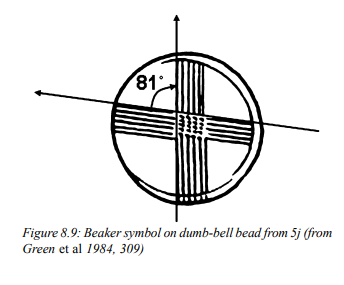
That 81 degree angle
An edited extract from Martin, Andrew. (2011). The Alien Within: The forgotten sub-cultures of Early Bronze Age Wessex.
https://www.academia.edu/download/39689730/Martin_2011_The_Alien_Within.pdf
The Net Down cemetery in Shrewton:This angle is also replicated in other Beaker symbols such as the Bush barrow lozenge from Wilsford G5, a barrow adjacent to another anomaly, Wilsford G7. We may never know for sure the significance of this angle, but its presence in contexts of interaction indicates that it held some importance. Many archaeologists have associated it with the angular distance between the midsummer and midwinter sunrise – 81 degrees at the latitude of Stonehenge. Indeed an angle of 82 degrees is found on the Sky Disc of Nebra, the angular distance between the solstices at the latitude of Saxony/Anhalt, where the Sky Disc was found.
Wednesday, 12 April 2023
Stonehenge: A History a lecture by Mike Pitts at Gresham College
Our contemporary ideas about Stonehenge and British antiquity were shaped in times of empire and war. They dominate popular histories and inform national identity.
Focusing on how Stonehenge was built, and drawing on a wealth of evidence which includes new archaeology and science, this lecture describes an alternative narrative of ancient communities, and presents a more positive and inclusive story – a Stonehenge re-imagined for modern Britain.
Friday, 7 April 2023
Is this the earliest depiction of Stonehenge?
Thursday, 6 April 2023
Stonehenge: The Little ‘Big Other’ Author: Mike Parker Pearson
Stonehenge: The Little ‘Big Other’
Mike Parker Pearson
Journal of Urban Archaeology 2023 7:, 147-168
The distribution of Late Neolithic henges and stone circles (c.3600 - 2300 BC) in central southern England. Drawing by Irene de Luis. Click to embiggen.
Abstract:
Whilst Stonehenge cannot be considered urban, this famous stone circle was part of a much larger complex which included not only other monuments and significant topographic features but also extensive areas of late Neolithic and Chalcolithic settlement during 2500-2200 bc. The unusually large settlement at Durrington Walls, less than 3 km to the east of Stonehenge, appears to have been occupied primarily seasonally and by people who brought their livestock from many different parts of Britain. With the arrival of Beaker-users, the settlement focus shifted to the west of Stonehenge. There is growing evidence that the Stonehenge complex was not a central place but a ‘peripheral place’, located on what may have been a long-term cultural boundary within southern Britain.Sunday, 2 April 2023
Who was Captain Beamish, excavator of Stonehenge?
With the confirmation that a Salisbury Museum sample labelled as being from the Altar Stone matches the Altar Stone the circumstances of its collection are worth noting. I have covered most of it before:
https://www.sarsen.org/2022/09/the-altar-stone-sample-provenance.html
The sample is from an 1844 excavation by a "Captain Beamish from Devonport" at the instigation of a Swedish gentleman looking for skeletons.
The obvious assumption is that Captain Beamish was a naval officer, especially as distinguished naval officers had that name - https://archivesearch.lib.cam.ac.uk/repositories/9/resources/1420 Rear Admiral Henry Hamilton Beamish, Rear Admiral Tufton Percy Hamilton Beamish, Lord Chelwood of Lewes (Tufton Victor Hamilton Beamish)
However the earliest Henry Hamilton Beamish was born in in 1829 and didn't join the Navy until 1845 and didn't become a Captain until 1864 https://www.pdavis.nl/ShowBiog.php?id=1570 (His son, also Henry Hamilton Beamish was a nasty antisemite https://en.wikipedia.org/wiki/Henry_Hamilton_Beamish ) So he isn't the Captain Beamish we are looking for.
Another branch of the Beamish family has a much more likely candidate. Richard Beamish 1798-1873.
https://www.wikitree.com/wiki/Beamish-290 for his life story - He had been a Captain in the Grenadier Guards. His obituary: https://www.icevirtuallibrary.com/doi/epdf/10.1680/imotp.1875.22714
The 1844 date hints at a connection to the Ethnological Society of London meeting of 25th May 1844 https://www.jstor.org/stable/3014114?seq=2 The members had a great interest in ancient skulls and were heavily influenced by the racist Phrenology theories of the Swedish Anders Adolph Retzius .
Richard Beamish had become a FRS in 1834 and was interested, wrote and lectured about phrenology, the study of skull shapes. His profession, however, was a civil engineer and he worked for Brunel, and wrote a biography of the great Engineer. In 1844 the first plans for what eventually became the Royal Albert Bridge over the Tamar were drawn up by Brunel and, of course, the eastern end is in the Devonport area. It seems likely that Beamish would have been in the area helping draw up the plans.
That a civil engineer was asked to lead an excavation at Stonehenge would not be unique.
Richard's brother North Ludlow Beamish had a great interest in Norse and Baltic Antiquities but was a Major and living in Ireland at the time.
So I believe it is highly likely that the Captain Beamish who excavated at Stonehenge in 1844 was Richard Beamish 1798-1873
It unfortunate that so much of the Victorian interest in Stonehenge was driven by racist theories, and even more so that temporal racism still drives many theories about the monument, in the words of Thor Heyerdahl after a sleepover at Stonehenge in 1944, "the irremediable problem with the world is that people are dumb and self-centred. This idiocy and in-group mentality results not only in industrial bloodshed and ethnocentrism, but in the superiority complex of modern civilisation over those past. Praising the genius of the Stonehengers, he ridiculed modern man’s proneness to deem his predecessors a moronic bunch."
Some of Richard's correspondence is in the Science Museum
Image used under Creative Commons Attribution-NonCommercial-ShareAlike 4.0 LicenceIntriguingly the letter in the photograph to Richard appears to be in a very similar hand to that of the label, but that might just be a coincidence.