Thursday, 28 July 2022

Anti-Bird netting at Stonehenge - the details of the trial.

 After the unexpected kerfuffle following my tweet about the anti-bird netting at Stonehenge I asked for details of the "trial, conducted in consultation with Historic England, "closely monitored over a year's cycle" which is being undertaken on the effects of the anti-bird netting installed in September 2021 under some of the lintels at Stonehenge". 


The response:

"English Heritage have confirmed that during the Stonehenge Lintels project last year we went to some lengths to protect the lichens on the stones and discussed how we might reduce the amount of bird excrement mainly from the rooks. We did not have a specific report written on this but it was discussed with the lichenologist who advised us about the protection of the lichens during the works and also the geologist who had recently studied the sarsens.

Following further discussions with the Inspector of Ancient Monuments (Historic England) we decided to trial inserting powder coated mesh into three of the many recesses under the lintels without any fixings which we could monitor along with the mortar that had been replaced. The mesh will be checked in September along with the works in general and a decision made then about whether or not to remove it. There is no plastic netting anywhere at Stonehenge as we are aware that birds can get caught up in it. We are very protective of the wildlife at Stonehenge. Following consultation with the specialists involved it was felt that we should look to prioritise the protection of the stones themselves and the protected lichens in situ.

As the trial is not yet complete, English Heritage do not hold any results. Please be aware that we cannot keep information requests open indefinitely, however if you wish to place a further request in the future you are more than welcome to do so."

The information they have released is below, click to embiggen:
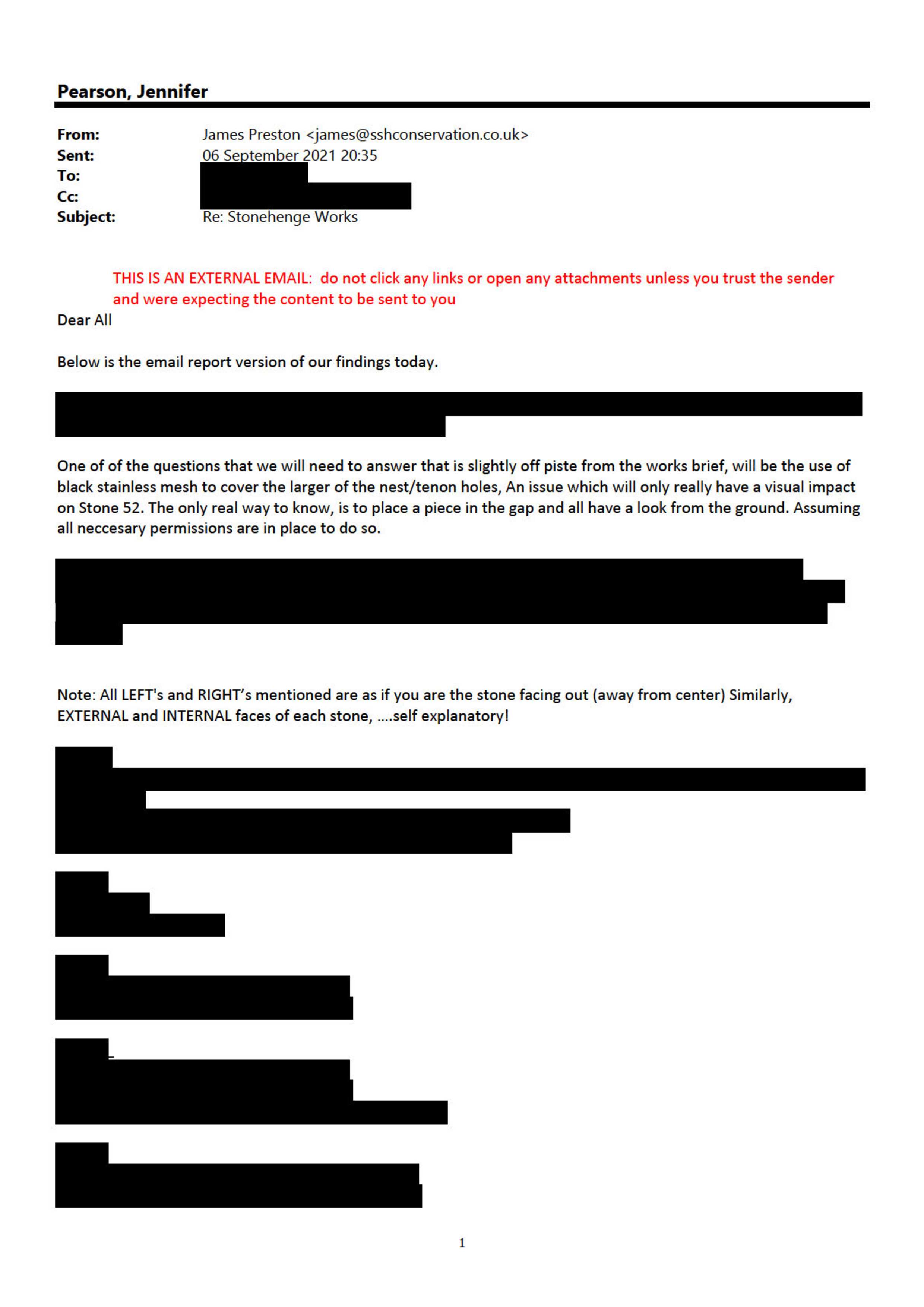
The Works emails:


The Lintel emails.


Scheduled Monument Consent is not a replacement for Planning Permission

Custodians of Scheduled Monuments know that Scheduled Monument Consent (SMC) is required for most works and other activities that physically affect a scheduled monument. In practice this is a very strict regime under which very little, if any, disturbance of the monument is possible without consent, apart from activities covered by Class Consent and which are most commonly relied upon are those relating to agriculture, horticulture (gardening) and works urgently needed in the interests of safety and health.

SMC is separate from the statutory planning process. However, the two processes can run in parallel if planning permission is also required for proposed works to a Scheduled Monument - (Source).  It is analogous to Listed Building Consent, it is an additional consent needed not a replacement to the normal planning permission requirement.

Planning permission is also needed if the work being carried out meets the statutory definition of ‘development’ which is set out in section 55 of the Town and Country Planning Act 1990. In this Act, except where the context otherwise requires, “development,” means the carrying out of building, engineering, mining or other operations in, on, over or under land, or the making of any material change in the use of any buildings or other land.

The categories of work that do not amount to ‘development’ are set out in section 55(2) of the Town and Country Planning Act 1990. These include building operations which do not materially affect the external appearance of a building. The term ‘materially affect’ has no statutory definition, but is linked to the significance of the change which is made to a building’s external appearance.

It seems that obtaining an SMC has been too often an excuse to not to also obtain Planning Permission, and to avoid the democratic overview that the planning system provides and the obtaining an SMC doesn't. Planning permission approval also provides environmental protections and a range of conditions can be applied.

If any cases come to mind now or in the future remember the appropriate remedies are available. 


Remember this is not legal advice - I'm not a lawyer and it is worth what you paid for it, nothing. It is just my opinion.

Tuesday, 26 July 2022

Bats at Stonehenge - absence of evidence is not evidence of absence.

I was surprised to learn from a Freedom of Information request that English Heritage believe that there are never any bats at Stonehenge: " there has never been any evidence of bats within the stone circle, neither physical or anecdotal. During planning applications for the new visitor centre in 2009, ecology surveys were carried out, and no evidence of bats was found. Therefore it was not deemed a necessary use of funds to commission a bat survey in 2021. " https://www.whatdotheyknow.com/request/stonehenge_bat_survey

This was a response to a query as to whether a bat survey had been undertaken before bird netting was installed in the trilithons in 2021.

The bat survey of 2008 can be found at in the planning bundle for application  S/2009/1527 on the Wiltshire planning portal

It doesn't find any bats at the Stone Circle, because they didn't look there!

The nearest they looked was at Durrington Down and Fargo Wood, where there were lots of bats. 


English Heritage also had a Bat survey  in 2003  which can be found in the planning bundle for Planning Application S/2004/0001

The conclusion for the Stonehenge Landscape : All ten species of bat were recorded regularly with only one species recorded fewer than 10 times during the 2003 surveys. The bat assemblage is assessed as being of National Importance due to the species diversity, the level of use by foraging and commuting bats and the number of roosts found during relatively limited surveys.

Again they didn't survey the actual Stone Circle but bats were found close to it.


For a more recent bat survey Highways England has done one on the route of the A303 in 2018

They monitored the A303 including the drove crossing point by the Stone Circle - "Crossing point 2018_3"

"A total of 18 bats were recorded at crossing point 2018_3 throughout the six survey visits. Species recorded included common pipistrelle, soprano pipistrelle, serotine, noctule and an unidentified bat."


So bats have been recorded north and south of the Stone Circle but the absence of evidence at the circle has been taken to be evidence of absence of bats in the ancient ring of stones with its quiet nooks and crannies, just perfect for a bat to rest in.


"Absence of a record does not mean there are no bats. It could mean there is no survey data available for that location. 

A survey is needed if one or more of the following applies: distribution and historical records suggest bats may be present.. the development site includes buildings or other built structures,.. that provide roosting opportunities for bats 

All bat species are designated and protected as European protected species (EPS). EPS are protected under the Conservation of Habitats and Species Regulations 2017. 

It is an offence to: damage or destroy their breeding sites and resting places (even when bats are not present) possess, control or transport them (alive or dead) 

It is also an offence under the Wildlife and Countryside Act 1981 to intentionally or recklessly: disturb bats while they occupy a structure or place used for shelter or protection obstruct access to a place of shelter or protection 

Several species of bats are listed as rare and most threatened species under Section 41 of the Natural Environment and Rural Communities Act (2006). You must have regard for the conservation of Section 41 species as part of your planning decision.


The definitive book - Bat Roosts in Rock: A Guide to Identification and Assessment provides this handy guide to the law:


Friday, 22 July 2022

Waun Mawn is like a box of chocolates

The latest Waun Mawn paper - citation below - is an excellent example of the self-correcting nature of good science. Researchers have continued to analyse the data and have changed their hypothesis as they report the new results. There is no gotcha about this. As John Maynard Keynes is reputed to have said, but it was probably Paul Samuelson more recently, “When the facts change, I change my mind. What do you do, sir?” 

I do have one quibble with it though.

I think Nick Pearce's statistical analysis doesn't go far enough and downplays the probability of Waun Mawn stones being used at Stonehenge.

The paper presents a full worked examination of the probability of the missing stones, the eight that are thought to have been removed, being of Lladron origin. There being no Lladron stones at Stonehenge this is the equivalent of any Waun Mawn stones being moved to Stonehenge.

This calculation is based on the the choice of stones to be removed being completely random. This a necessary and useful first calculation to make but it doesn't go far enough because we can make the valid prior assumption that before choosing a stone to take the physical and or spiritual characteristics of the stone would have been assessed.

On Christmas Day afternoon when the the Quality Street tin is passed around you know there were twelve chocolates left at lunch time. Now when it is your turn to choose there are just four Orange Cremes left.

Is it a valid to assume that the original twelve were all Orange Cremes?

No. You can reasonably assume that the Purple ones and the Green triangles would have been preferentially chosen before the Orange Cremes. The twelve could have been any mix that included four Orange Cremes.

I think the same applies to the Waun Mawn stones. The probability that some were removed to Stonehenge is not properly described by the calculation in the paper. What the true probability is and whether they actually were is another matter.

Incidentally the same applies to the stones removed at Stonehenge, why were some removed completely and other left alone? It is unlikely to be a completely random choice. 


Contents of our Quality Street tin Xmas 2021

Citation:

Richard E. Bevins, Nick J.G. Pearce, Mike Parker Pearson, Rob A. Ixer,

Identification of the source of dolerites used at the Waun Mawn stone circle in the Mynydd Preseli, west Wales and implications for the proposed link with Stonehenge,
Journal of Archaeological Science: Reports,
Volume 45,
2022,
103556,
ISSN 2352-409X,

Wednesday, 20 July 2022

That Stonehenge is a "second-hand circle" story - the science is here.


TLDR summary - Probably not from Waun Mawn.

Excellent to see science that is open minded and self-correcting.  
 

Richard E. Bevins, Nick J.G. Pearce, Mike Parker Pearson, Rob A. Ixer,
Identification of the source of dolerites used at the Waun Mawn stone circle in the Mynydd Preseli, west Wales and implications for the proposed link with Stonehenge,
Journal of Archaeological Science: Reports,
Volume 45,
2022,
103556,
ISSN 2352-409X,


Abstract: A Neolithic stone circle at Waun Mawn, in the Mynydd Preseli, west Wales, has been proposed as the original location of some dolerite megaliths at Stonehenge, including one known as Stone 62. To investigate this hypothesis, in-situ analyses, using a portable XRF, have been obtained for four extant non-spotted doleritic monoliths at Waun Mawn, along with two weathered doleritic fragments from a stonehole (number 91). The data obtained have been compared to data from spotted and non-spotted dolerite outcrops across the Mynydd Preseli, an area known to be the source of some Stonehenge doleritic bluestones, as well as data from in-situ analysis of Stone 62 (non-spotted dolerite) and ex-situ analysis of a core taken from Stone 62 in the late 1980′s. Recently, Stone 62 has been identified as coming from Garn Ddu Fach, an outcrop some 6.79 km to the east-southeast of Waun Mawn. None of the four dolerite monoliths at Waun Mawn have compositions which match Stonehenge Stone 62, and neither do the weathered fragments from stonehole 91. Rather the data show that the Waun Mawn monoliths, and most probably the weathered stonehole fragments, can be sourced to Cerrig Lladron, 2.37 km southwest of Waun Mawn, suggesting that a very local stone source was used in construction of the Waun Mawn stone circle. It is noted that there is evidence that at least eight stones had been erected and subsequently removed from the Waun Mawn circle but probability analysis suggests strongly that the missing stones were also derived, at least largely, from Cerrig Lladron.


Monday, 18 July 2022

£100 up for grabs

Elsewhere I posted "give me the details of a single glacial stone that is in its natural placement, or reliably recorded before being humanly moved, on Salisbury Plain. A bet: I'll give £100 to your favourite charity if you can and £100 to mine if you can't, from you."

The world's leading expert on Salisbury Plain Glacial Erratics has refused to take the bet but insists there are lots of them.

My response: "Put up or shut up"

If you know better claim the money.


Friday, 15 July 2022

Detmar Blow and the Meteorite - Andrew Ziminski's Theory.

UPDATE - an 1899 photograph of it has been found in place, which refutes this theory.  https://collections.salisburymuseum.org.uk/object/SBYWM:1947.39.9


In 2013 I theorised that the big pit in front of the middle trilithon may have once held the Lake House meteorite. https://www.sarsen.org/2013/04/the-mystery-pit-in-centre-of-stonehenge.html

The Lake House Meteorite a 92.75kg stone landed about 30,000 years ago, no crater has been found so it may have been onto the Ice Age ice at that time, and may not have been anywhere near Stonehenge. About 10,000 years ago it was exposed to the elements and started weathering. About 4000 years ago it was buried in the local chalk before being dug up in probably Victorian times.


My theory was that this strange stone was brought to Stonehenge very early on, it was buried in the holiest central position in recognition of its unique qualities. A generation or so later it was decreed that some leader's tomb, or other place was more fitting for it and so like the Stone of Scone it was moved to please the leader. This involved excavating the pit to find and remove it. The pit was then filled in and the bluestone horseshoe erected.

I think the pit isn't for erecting something or burying something, it looks more like a quarrying pit used to extract something heavy that was already buried  in front of the Great Trilithon. To bury or erect a stone a steep sided hole fits the purpose, but to drag something out a shallow slope is needed, in the absence of lifting gear,

Our Victorian diggers then found it in its secondary burial place in a barrow.

It is remiss of me that I have not mentioned Andrew Ziminski in his brilliant book The Stone Mason refines this theory by wondering if instead of Rev.Edward Duke or his ilk finding it in a barrow in the early part of Victoria's reign it was actually found by Detmar Blow in the big pit in the centre of Stonehenge. Detmar Blow was not only entrusted with the 1901 remedial work at Stonehenge, which involved with Gowland the excavation to the edge of the big pit as they straightened Stone 56  but he was also in charge of restoring Lake House in 1898 and subsequent work there. The theory being that it was found and removed in 1901 during Gowland's excavations by Blow and taken to Lake House as a curio.

There doesn't seem to be any record of the meteorite at Lake House before 1905 so Andrew's theory is appealing.

UPDATE September 2024 - an 1899 photograph of it has been found in place, which refutes this theory.  https://collections.salisburymuseum.org.uk/object/SBYWM:1947.39.9


-------


Stonehenge by Mike Parker Pearson in Chapter 8 p.129 - 132 discusses the large pit in the centre of Stonehenge:


He pieces together evidence about it from excavations by Atkinson, Hawley and Gowland and concludes it dates to 2440-2100 BC, after the Great Trilithon was erected and that it was filled back up in prehistory because a bluestone was set into it as part of the inner oval of bluestones.

Atkinson thought it was the ramp for the erection of Stone 56 - photos below - but MPP shows it wasn't. The dark area of the ramp can be seen on the side of the excavation leading down towards the base of 56 but  it is too shallow to be of use and doesn't join up to Gowland's excavation around the base of 56.


MPP declares the purpose of this huge pit, estimated as 12 metres long, 5 metres wide and 2.4 metres wide to be a "complete mystery". The size is very approximate as edges haven't been found.