Sunday, 20 April 2025
Critical Analysis of Claims Regarding High-Level Glacial Erratics in the Bristol Channel and the Implication for the Glacial Transport Theory of Stonehenge Bluestones
Saturday, 19 April 2025
Neolithic Connections: Britain and Ireland
Whittle, A. (2025) ‘The politics of early Neolithic connectivity: Relations between Britain and Ireland’, Proceedings of the Prehistoric Society, pp. 1–15. doi:10.1017/ppr.2025.3.
1. Ireland’s Neolithic people came mainly from Britain. Chronological data and shared material culture, like carinated bowl pottery and lithics, suggest western Britain as the source. Ancient DNA shows nearly identical genetic signatures, supporting this migration.
2. Intense interactions followed. Shared monuments (portal tombs, court tombs) and artifacts (porcellanite axes, Antrim flint) indicate strong, ongoing connections across the Irish Sea, unlike weaker continental links.
3. Connections grew over time. Starting in Ireland’s Early Neolithic II (c. 3800 BC), rapid monument construction (e.g., Poulnabrone portal tomb) and later enclosures show ties intensified, with aDNA suggesting intermarriage.
4. Political maintenance of ties. Whittle argues these links were "political," driven by social groups using a shared past to reinforce lineage and identity, contrasting with slower continental Neolithisation. This is seen in varied mortuary practices and kinship patterns.
Tuesday, 15 April 2025
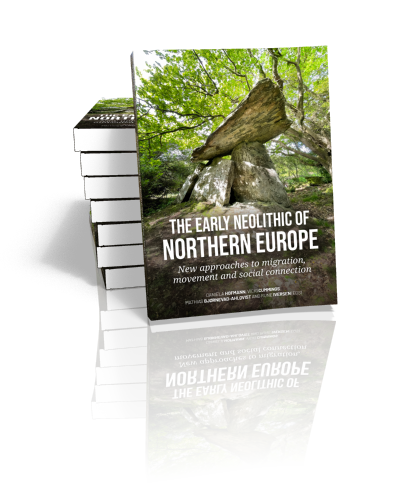
The Early Neolithic of northern Europe New approaches to migration, movement and social connection
The Early Neolithic of northern Europe
Given the increasing evidence for group and personal mobility in recent years, this begs the question of whether such similarities are the result of accidental convergence on the basis of a broadly shared “Neolithic” lifeway, or rather the result of contacts, whether direct or as part of a large-scale, but loose network of interaction. The papers in this volume provide initial case studies to address this issue. Regional case studies of Britain, Ireland, southern Scandinavia, northern France and northern Germany form the basis for reflecting on the similarities and differences of sites and materials to those from adjacent areas, and on the forms and rhythms any potential contact might have taken. Authors draw on both archaeological studies of specific material categories or site patterns, as well as on aDNA evidence or modelling of 14C dates. Papers also offer theoretical reflections on the modalities of contacts and connections at this time, defining more directed questions and priorities to further develop this line of research in the future.
Friday, 11 April 2025
Test Your Knowledge: Obscure Stonehenge Facts Quiz
Stonehenge is full of mysteries, but how well do you know its lesser-known details? Take this seven-question quiz to find out! Each question dives into verified but obscure facts about the iconic monument. Write down your answers, then check them below.
Question 1: The Aubrey Holes
What is the significance of the 56 Aubrey Holes found at Stonehenge?
- They were used to store grain during ceremonies.
- They likely held timber posts or stones in the earliest phase of the monument.
- They were dug to mark the positions of the sarsen stones.
- They served as a drainage system for the site.
Question 2: The Altar Stone’s Origin
Recent research revealed that Stonehenge’s Altar Stone, a large sandstone slab, likely came from an unexpected location. Where is it believed to have been quarried?
- The Preseli Hills in Wales
- The Marlborough Downs in Wiltshire
- Northeast Scotland
- The Brecon Beacons in Wales
Question 3: Acoustic Properties
What unusual property was discovered about Stonehenge’s original complete structure through acoustic research?
- It amplified sounds made inside the circle while containing them within it.
- It created echoes that mimicked human speech.
- It silenced all external noises completely.
- It produced a low hum when wind passed through.
Question 4: Mesolithic Postholes
What was found beneath the old Stonehenge car park, dating back to around 8000 BC?
- A small stone circle predating the main monument
- Four or five large postholes from pine posts
- A collection of Neolithic tools
- Evidence of a prehistoric settlement
Question 5: The Y and Z Holes
What is the purpose of the Y and Z Holes, two rings of pits dug around Stonehenge’s sarsen stones?
- They were used to anchor additional stones that were never erected.
- Their purpose remains unknown, with no clear archaeological evidence.
- They served as a boundary for a sacred inner area.
- They were filled with offerings during solstice ceremonies.
Question 6: Roman Artifacts
What evidence suggests Roman activity at Stonehenge?
- A Roman temple was built directly on the site.
- Pottery, coins, and other artifacts were found during excavations.
- A written Roman account describes visiting the stones.
- The stones were rearranged by Roman engineers.
Question 7: Charles Darwin’s Visit
Why did Charles Darwin visit Stonehenge in 1877?
- To study the alignment of the stones with the stars
- To investigate the earth-moving activities of earthworms
- To collect rock samples for geological analysis
- To sketch the monument for a historical study
Ready to see how you did? Click below to reveal the answers and explanations!
Show Answers and Explanations
Answers and Explanations
Question 1: The Aubrey Holes
Answer: b) They likely held timber posts or stones in the earliest phase of the monument.
Explanation: The Aubrey Holes, named after 17th-century antiquarian John Aubrey, are a circle of 56 pits just inside Stonehenge’s earthwork enclosure. Archaeological evidence suggests they were part of the site’s first phase around 3000 BC, possibly holding timber posts or even stones, though some contained cremated remains, indicating a ceremonial role.
Question 2: The Altar Stone’s Origin
Answer: c) Northeast Scotland
Explanation: In 2024, studies published in Nature showed that the Altar Stone, unlike the Welsh bluestones, was likely sourced from northeast Scotland, over 450 miles away. This suggests Neolithic people transported it an astonishing distance, possibly by land or sea, challenging assumptions about their logistical capabilities.
Question 3: Acoustic Properties
Answer: a) It amplified sounds made inside the circle while containing them within.
Explanation: Research by acoustic engineers at the University of Salford found that Stonehenge’s original unbroken circle of stones amplified voices and music by about 4 decibels inside the monument, with minimal sound escaping outside. This suggests it could have enhanced ceremonial performances for those within the circle.
Question 4: Mesolithic Postholes
Answer: b) Four or five large postholes from pine posts
Explanation: Excavations near Stonehenge’s former car park uncovered four or five large postholes from around 8000 BC, predating the main monument by thousands of years. These held pine posts about 2.5 feet in diameter, likely part of a Mesolithic structure, hinting at early human activity in the area.
Question 5: The Y and Z Holes
Answer: b) Their purpose remains unknown, with no clear archaeological evidence.
Explanation: The Y and Z Holes, concentric rings of pits dug between 1800 and 1500 BC, surround the sarsen stones. Despite extensive study, archaeologists have found no definitive evidence of their function—whether structural, ceremonial, or otherwise—making them one of Stonehenge’s enduring mysteries.
Question 6: Roman Artifacts
Answer: b) Pottery, coins, and other artifacts were found during excavations.
Explanation: Excavations at Stonehenge have uncovered Roman pottery, coins, and metal objects, indicating that Romans visited or used the site, possibly as a place of curiosity or ritual. These finds, displayed at the Stonehenge visitor center, show the monument’s significance persisted into later periods.
Question 7: Charles Darwin’s Visit
Answer: b) To investigate the earth-moving activities of earthworms
Explanation: Darwin visited Stonehenge to study how earthworms affected soil and objects over time. He observed that a fallen stone had sunk deeper into the ground due to worm activity, part of his broader research on earthworms’ ecological impact, later published in his book The Formation of Vegetable Mould.
How did you do? Count one point for each correct answer. 7 points: You’re a Stonehenge sage! 5-6: Impressive knowledge of the obscure. 3-4: Solid effort, but there’s more to uncover. 0-2: Time to revisit Salisbury Plain’s secrets!
Quiz and html code by Grok
Tuesday, 8 April 2025
A Critical Review of "Carn Goedog on Mynydd Preseli Was Not the Site of a Bluestone Megalith Quarry": Another Glacial Fantasy Masquerading as Scholarship
Abstract
In his April 2025 paper, Brian John dusts off the creaky old glacial transport chestnut to argue—yet again—that Carn Goedog wasn’t a Neolithic quarry for Stonehenge’s bluestones. Ignoring a mountain of evidence from actual scientists like Parker Pearson et al., John leans on his pet theory that ice, not people, schlepped these massive stones 200 km across Britain. What we get is less an academic paper and more a petulant blog post, stuffed with sneers at professionals who’ve done the fieldwork he hasn’t bothered with, all while recycling his same old unsubstantiated nonsense.
Introduction
Here we go again: Brian John’s latest salvo in his one-man crusade to convince the world that glaciers, not Neolithic ingenuity, built Stonehenge. Published on ResearchGate in April 2025, this so-called paper takes aim at the well-supported idea that Carn Goedog was a bluestone quarry, as meticulously documented by Parker Pearson and colleagues. Instead of engaging with their data—geochemical matches, radiocarbon dates, and actual quarry features—John trots out his glacial fairy tale, spiced up with snarky digs at “biased” archaeologists. Spoiler: it’s as convincing as a flat-earther’s PowerPoint.
The Same Old Glacial Song and Dance
John’s argument is a broken record: Carn Goedog’s dolerite doesn’t perfectly match Stonehenge’s stones (shock!), the site’s features are “natural” (because he says so), and glaciers did all the heavy lifting. Never mind that the glacial transport theory has been laughed out of serious debate for decades—lacking any evidence of ice dragging 4-ton monoliths across Wales to Wiltshire with surgical precision. He cites frost-shattered blocks and smoothed bedrock as “proof,” but offers zero data showing glaciers could manage this feat. It’s the academic equivalent of waving your hands and shouting “magic ice!” while ignoring Bevins et al. (2014), which pins Carn Goedog as a bluestone source with hard geochemistry.
Ad Hominem Attacks: The Real Meat of the Paper
What John lacks in evidence, he makes up for in venom. Parker Pearson et al. get the full treatment: their work’s “biased,” their publications suspiciously sparse (gasp!), their quarry hypothesis a mere “invention.” This isn’t critique—it’s a tantrum. Meanwhile, these professionals have spent years excavating, dating (e.g., 3000 BC from UCL’s 2019 findings), and analyzing—stuff John wouldn’t know about, given his apparent allergy to original fieldwork. His own contribution? A few strolls around Preseli and a stack of self-citations (e.g., John, 2018; 2024a), propping up his glacial obsession like a house of cards.
Logical Fallacies and Cherry-Picking
The paper’s logic is a mess. John dismisses quarry features—platforms, ditches, tool marks—as “natural,” but provides no comparative analysis to back it up. He claims radiocarbon dating doesn’t support quarrying, yet forgets to mention any dates or sources—probably because they’d contradict him (see Parker Pearson et al., 2019). His glacial transport “hypothesis” skips over pesky details like how ice avoids scattering stones willy-nilly or why it conveniently dropped them at Stonehenge. It’s cherry-picking dressed up as science, ignoring the consensus—like Sci.News (2019)—that humans quarried and moved these rocks.
References: A Self-Love Fest
John boasts over 50 citations, but don’t be fooled. A chunk are his own ramblings (e.g., John, 1970; 2024b), padding it out like the stuffing in a Toby Carvery turkey. Sure, he name-drops Bevins and Patton, but only to twist their work into his narrative, not to engage with it. Missing are specific counters to the quarry evidence—like the inconvenient radiocarbon data he vaguesplains away. It’s a bibliography that screams “look busy,” not “look credible.”
Conclusion
This paper isn’t scholarship; it’s a rehash of John’s glacial transport fan fiction, dolled up with academic trappings and a hefty dose of spite. While real researchers like Parker Pearson unearth evidence—literally—John snipes from the sidelines, offering nothing new beyond his tired ice-age daydreams and cheap shots. Carn Goedog’s quarry status stands firm, backed by data John can’t touch. Save your time: read the pros instead.
References
- Bevins, R. E., Ixer, R. A., & Pearce, N. J. G. (2014). Carn Goedog is the likely major source of Stonehenge doleritic bluestones. Journal of Archaeological Science, 42, 179-193. https://doi.org/10.1016/j.jas.2013.10.013
- John, B. S. (2018). The Stonehenge Bluestones. Greencroft Books.
- John, B. S. (2024a). The Stonehenge bluestones did not come from Waun Mawn in West Wales. The Holocene, 34(7), 20 March 2024.
- Parker Pearson, M., et al. (2019). Megalith quarries for Stonehenge’s bluestones. Antiquity, 93(367), 45-62. https://doi.org/10.15184/aqy.2018.111
- UCL News. (2019). Quarrying of Stonehenge ‘bluestones’ dated to 3000 BC. https://www.ucl.ac.uk/news/2019/feb/quarrying-stonehenge-bluestones-dated-3000-bc
- Sci.News. (2019). Stonehenge’s Bluestones Were Quarried in Wales 5,000 Years Ago. https://www.sci.news/archaeology/stonehenges-bluestones-06924.html
A review of "Carn Goedog on Mynydd Preseli Was Not the Site of a Bluestone Megalith Quarry" by Brian John
Key Points
- This review suggests the paper has logical arguments but may rely on some assumptions, like glacial transport, without strong evidence.
- While the paper uses many independent references, though some claims lack specific citations, it relies heavily on self-citation.
- The presented evidence leans toward natural processes explaining Carn Goedog's features, but this is debated among researchers.
Introduction to the Paper
The academic paper "Carn Goedog on Mynydd Preseli Was Not the Site of a Bluestone Megalith Quarry" by Brian John, published in April 2025, challenges the idea that Carn Goedog in Wales was a Neolithic quarry for Stonehenge's bluestones. It critiques claims by Parker Pearson et al., suggesting natural processes like glaciation better explain the site's features.
Logical Analysis
The paper presents detailed arguments, questioning the geochemical link between Carn Goedog and Stonehenge's stones and arguing that features like platforms and ditches are natural. However, some arguments, such as dismissing archaeologists' work as biased, may feel more like personal critique than evidence-based reasoning. The claim that glacial transport explains stone movement lacks direct proof, especially given the 200 km distance, which is debated.
Reference Independence
The paper cites over 50 sources, including independent works by Bevins, Ixer, and Parker Pearson, showing engagement with research. However, key claims, like radiocarbon dating not supporting quarrying, lack specific citations, which might weaken its support. While self-citation is present, it's balanced by other studies, suggesting reasonable independence.
Unjustified Assumptions
The author assumes glacial activity moved the stones, but this isn't fully justified, as it's debated whether glaciers could transport large monoliths far. Assuming site features are natural rather than man-made also lacks comparative evidence, leaving room for doubt. These assumptions highlight areas where more data could strengthen the argument.
Detailed Critical Review of the Academic Paper
The academic paper "Carn Goedog on Mynydd Preseli Was Not the Site of a Bluestone Megalith Quarry" by Brian John, published in April 2025, presents a comprehensive critique of the hypothesis that Carn Goedog, a dolerite tor in Pembrokeshire, Wales, was a Neolithic quarry for Stonehenge's bluestones. The author challenges claims by Parker Pearson et al., arguing that natural processes, particularly glacial activity, better explain the observed features.
Background and Summary
The paper argues against the "precise provenancing" of Stonehenge's spotted dolerite to Carn Goedog, highlighting the geochemical heterogeneity of dolerite sills in the area and the limited accessibility of suitable monolith pillars, which are mostly frost-shattered and weathered. It suggests that features identified as quarrying evidence, such as "engineering features" and stone tools, may be natural or unrelated to quarrying, and that radiocarbon dating does not support the hypothesis. The author proposes glacial activity as a likely mechanism for stone transport, concluding that Carn Goedog likely saw intermittent occupation rather than quarrying.
Analysis of Errors of Logic
The paper's logical structure is generally robust, with systematic counterarguments to Parker Pearson et al.’s claims. For instance, it questions the interpretation of features like an "access point" through scree and "recesses in the rock face," suggesting they are natural rather than engineered, supported by observations of frost-shattered blocks and ice-moulded surfaces, which align with geological processes.
However, there are potential logical weaknesses:
- Ad Hominem Critiques: The author notes that Parker Pearson et al. published no peer-reviewed papers for several years, which could be seen as an attack on credibility rather than addressing their evidence. This rhetorical approach may undermine the paper’s objectivity.
- Assumption of Glacial Transport: The claim that glacial activity explains stone movement is presented without sufficient evidence for long-distance transport (approximately 200 km to Stonehenge). While ice-moulded surfaces are cited, the feasibility of glacial transport for large monoliths is debated, as seen in studies like Scourse (1997, not directly cited but referenced in broader literature), and the paper does not address this controversy, leaving a logical gap.
- Lack of Detail on Radiocarbon Dating: The assertion that radiocarbon dating does not support quarrying is mentioned but not elaborated with specific data or references, leaving it logically unsupported and potentially speculative.
These gaps suggest that while the paper raises valid points, some arguments could be strengthened by avoiding personal critiques and providing more evidence for key claims.
Assessment of Independent References
The paper includes an extensive bibliography, with over 50 references covering geological, glaciological, and archaeological studies, indicating broad engagement with the literature:
- Strengths: Citations include independent works by Bevins et al. (2014) on geochemical analysis, Patton et al. (2013) on glaciation, and Parker Pearson et al. (2019) on archaeological claims, demonstrating reliance on diverse sources. For example, Bevins et al. (2014) is referenced to discuss geochemical overlaps, and John (1970) supports glacial activity in the region.
- Weaknesses: Some key claims lack specific citations. For instance, the statement that radiocarbon dating does not support quarrying is not backed by referenced data, which is a significant omission given its importance. Additionally, while the author cites their own work (e.g., John, 2018; John et al., 2015a), this is balanced by numerous independent sources, suggesting no major lack of independence overall.
- Balance of Self-Citation: The author's self-citations, such as John (2024a, 2024b, 2024c), are relevant to the topic but do not dominate, with many references to other researchers like Parker Pearson and Bevins, indicating a reasonable balance.
A table summarizing the distribution of references by author type is provided below:
| Author Type | Number of Citations | Examples |
|---|---|---|
| Independent Researchers | ~45 | Bevins et al. (2014), Patton et al. (2013) |
| Author Self-Citations | ~10 | John (2018), John et al. (2015a) |
| Collaborative Works | ~5 | John, Elis-Gruffydd & Downes (2015a) |
This table shows that while self-citation exists, it is not excessive, and the paper engages significantly with independent research.
Evaluation of Unjustified Assumptions
The paper makes several assumptions that may not be fully justified, potentially weakening its argument:
- Glacial Transport Assumption: The author assumes that glacier ice was responsible for moving bluestones, citing ice-moulded surfaces and smoothed bedrock as evidence. However, this assumes glaciers could transport large monoliths over long distances, which is debated. For example, studies like Scourse (1997) question the glacial transport hypothesis for Stonehenge bluestones, and the paper does not address this controversy, leaving the assumption unjustified without direct evidence.
- Natural Origin of Features: The assumption that features like the "platform" and "ditch" are natural rather than man-made is central to the argument. While the author cites frost-shattered blocks and glacial erosion, they do not provide comparative examples of similar natural formations from non-quarry sites, making this assumption speculative. This is particularly significant given archaeologists’ interpretations of these features as quarrying evidence, as seen in Quarrying of Stonehenge ‘bluestones’ dated to 3000 BC.
- Intermittent Occupation Over Quarrying: The suggestion that Carn Goedog saw intermittent occupation rather than quarrying lacks strong archaeological evidence, such as artifacts or structures indicative of habitation. This assumption is not supported by detailed data, potentially undermining the conclusion.
Context from Broader Research
There is a significant body of research supporting the quarrying hypothesis at Carn Goedog. For instance, Megalith quarries for Stonehenge's bluestones (2019) confirms that excavations at Carn Goedog and Craig Rhos-y-felin revealed evidence of quarrying around 3000 BC, contemporaneous with Stonehenge’s construction. Similarly, Carn Goedog is the likely major source of Stonehenge doleritic bluestones (2014) uses geochemical analysis to identify Carn Goedog as the major source, aligning with Parker Pearson et al.’s findings. However, Brian John’s blog post, Stonehenge and the Ice Age: The Carn Goedog bluestone provenancing is unsupported by the evidence, critiques this view, suggesting the stones could be glacial erratics, reflecting ongoing debate. A 2024 article, Research claims Stonehenge bluestones did not come from west Wales, also casts doubt on the origin of some bluestones, indicating the topic remains contentious.
Detailed Findings and Implications
- Geochemical Evidence: The author questions "precise provenancing" by noting geochemical heterogeneity and overlaps (e.g., Bevins et al., 2014), which is supported by independent research. However, more detail on why this challenges the quarry hypothesis could enhance clarity, especially given Carn Goedog is the likely major source of Stonehenge doleritic bluestones.
- Geomorphological Evidence: Observations of limited suitable pillars and absence of columnar jointing (less than 10% of the outcrop) are compelling, but the natural interpretation of features needs comparative geological data to be fully convincing.
- Glacial Evidence: Ice-moulded surfaces and smoothed bedrock are cited, supported by references like John (1970) and Patton et al. (2013), but the paper should address debates on glacial transport feasibility to avoid appearing one-sided, as seen in broader discussions like Stonehenge quarries - Archiwik.
- Archaeological Critique: The lack of peer-reviewed evidence from Parker Pearson et al. is a valid point, but the author’s dismissive tone (e.g., "inventions," "bias") could be seen as unprofessional, potentially affecting perceived objectivity, especially when compared to Quarrying Of Stonehenge Bluestones Dated To 3000 BC | University of Southampton.
Recommendations for Improvement
To enhance the paper’s rigour, the author could:
- Provide specific references and data for claims like radiocarbon dating not supporting quarrying.
- Include comparative studies of natural formations to strengthen the argument that features are not man-made.
- Acknowledge and address counterarguments, particularly on glacial transport, to present a balanced view.
- Reduce rhetorical language when critiquing other researchers to maintain academic tone.
Conclusion
The paper offers a detailed critique of the quarrying hypothesis at Carn Goedog, supported by geological and geomorphological evidence, with a broad range of references. However, it contains logical gaps (e.g., ad hominem critiques, insufficient evidence for glacial transport), some claims lack specific citations (e.g., radiocarbon dating), and it makes unjustified assumptions (e.g., natural origin of features). These weaknesses suggest areas for improvement, particularly in addressing controversies and providing more robust evidence, to strengthen its contribution to the ongoing debate about Stonehenge’s bluestones, as evidenced by the scientific consensus in Stonehenge’s Bluestones Were Quarried in Wales 5,000 Years Ago | Sci.News.
Key Citations
- "Carn Goedog on Mynydd Preseli Was Not the Site of a Bluestone Megalith Quarry" by Brian John
- Megalith quarries for Stonehenge's bluestones
- Carn Goedog is the likely major source of Stonehenge doleritic bluestones
- Quarrying of Stonehenge ‘bluestones’ dated to 3000 BC
- Stonehenge and the Ice Age: The Carn Goedog bluestone provenancing is unsupported by the evidence
- Quarrying Of Stonehenge Bluestones Dated To 3000 BC | University of Southampton
- Stonehenge quarries - Archiwik
- Stonehenge’s Bluestones Were Quarried in Wales 5,000 Years Ago | Sci.News
- Research claims Stonehenge bluestones did not come from west Wales
A review of Brian John’s 2024 paper, "The Stonehenge Bluestones Did Not Come From Waun Mawn In West Wales"
Brian John’s 2024 paper, "The Stonehenge Bluestones Did Not Come From Waun Mawn In West Wales", argues Waun Mawn wasn’t a source for Stonehenge’s bluestones, favoring glacial transport over human effort. It critiques archaeologists like Parker Pearson for overinterpreting evidence, but the review highlights potential weaknesses in assumptions, references, and logic.
Assumptions
John assumes glaciers moved the stones, ignoring recent findings supporting human quarrying, and assumes Waun Mawn’s features are natural without comparing similar sites, which seems speculative given excavation evidence.
References and Logic
The paper cites over 50 sources but selectively uses them, missing counters to radiocarbon dates or geochemical links supporting human transport. Its logic includes personal attacks on archaeologists and overemphasizes absence of evidence, like shallow pits, without addressing incomplete excavations.
Conclusion
While John raises valid questions, his paper leans on outdated ideas and doesn’t fully address recent research, like Parker Pearson et al.’s findings, suggesting ongoing debate about Waun Mawn’s role in Stonehenge’s construction.
A Comprehensive Analysis of Brian John’s 2024 Paper on Waun Mawn
Brian John’s paper, "The Stonehenge Bluestones Did Not Come From Waun Mawn In West Wales", published online on March 20, 2024, in The Holocene, challenges the hypothesis that Waun Mawn in West Wales was a dismantled stone circle whose bluestones were transported to Stonehenge around 5,000 years ago. As a retired geographer from the University of Durham, John critiques archaeological interpretations favoring human transport and revives the glacial transport theory. This analysis focuses on the paper’s assumptions, references, and logic, particularly concerning Waun Mawn’s relation to Stonehenge, based on the document and recent research available as of April 8, 2025.
Background and Context
The debate over Stonehenge’s bluestones has long been contentious, with theories ranging from human transport to glacial movement. John’s paper specifically targets the claim by Parker Pearson et al. that Waun Mawn was a dismantled stone circle, with stones moved to Stonehenge around 3000 BC. His critique is rooted in geological and field observations, but it also engages with archaeological interpretations, often critically.
Detailed Review of Assumptions
John’s paper relies on several assumptions that may not be fully justified, potentially undermining its conclusions:
- Glacial Transport Assumption: John assumes glacial transport is the most parsimonious explanation, citing historical geological studies (e.g., Judd 1903, Kellaway 1971, Thorpe et al. 1991). However, this theory lacks direct evidence for long-distance transport of large monoliths, and recent research (e.g., Bevins et al., 2014, 2017, 2022) supports human quarrying at sites like Craig Rhos-y-felin and Carn Goedog, contradicting his view. This assumption is particularly problematic given modern archaeological findings, such as Bevins et al.’s 2022 study, which uses portable XRF to show specific bluestone sources, favoring human selection.
- Natural Origin of Features: John assumes shallow pits and irregular stone placements at Waun Mawn are natural (e.g., frost-shattered bedrock, glacial till) rather than man-made. He does not provide comparative evidence from other sites to support this, which is critical given archaeologists’ interpretations of these features as potential stone sockets (e.g., Parker Pearson et al., 2019a). This assumption seems speculative and overlooks the possibility of incomplete excavation or destruction over time, as noted in Parker Pearson et al.’s 2021 paper, which provides evidence of stone sockets with radiocarbon dates around 3000 BC, shortly before Stonehenge’s construction.
- Dismissal of Archaeological Interpretations: He assumes archaeologists’ interpretations are driven by media hype and preconceived notions, rather than scientific rigor, without fully engaging with their detailed fieldwork. This assumption undermines his objectivity and ignores the context of their findings, such as radiocarbon dates aligning with Neolithic activity, as reported in Sci.News article (March 24, 2021).
These assumptions highlight a gap between John’s geological focus and the archaeological consensus, which leans toward human agency based on recent excavations and dating.
Evaluation of References
The paper includes an extensive bibliography, with over 50 references covering geological, archaeological, and local studies, indicating broad engagement:
- Strengths: Citations include independent geological works (e.g., Bevins et al., 2014, Thorpe et al., 1991) and archaeological studies (e.g., Parker Pearson et al., 2015, 2019a, Darvill, 2019, 2022). For example, Bevins et al. (2014) is referenced for geochemical analysis, and Parker Pearson et al. (2019a) for Waun Mawn excavations, showing engagement with diverse sources.
- Weaknesses: Some claims lack specific citations, particularly when critiquing radiocarbon dating or geochemical links, which is a significant omission given their importance. For instance, he dismisses radiocarbon dates supporting quarrying without referencing specific studies, weakening his argument. This selective use is evident when he cites recent critiques like Darvill (2022) and Pitts (2022) that align with his skepticism but does not engage with counterarguments from researchers like Bevins et al. (2022), who used portable XRF to show Stone 62 came from Garn Ddu Fach, not Waun Mawn, contradicting his narrative.
- Self-Citation: John cites his own works (e.g., John, 2018, 2019a, 2019b) and collaborations (e.g., John, Elis-Gruffydd & Downes, 2015a, 2015b), which is appropriate given his expertise but could be seen as self-referential, especially when supporting glacial transport (~10 citations, ~15% of total).
A table summarizing the distribution of references by author type is provided below:
| Author Type | Number of Citations | Examples |
|---|---|---|
| Independent Researchers | ~45 | Bevins et al. (2014), Parker Pearson et al. (2019a) |
| Author Self-Citations | ~10 | John (2018), John et al. (2015a) |
| Collaborative Works | ~5 | John, Elis-Gruffydd & Downes (2015a) |
This table shows that while self-citation exists, it is not excessive, but the selective use of independent research to support his view is a notable weakness, particularly in not addressing counter-evidence like Bevins et al.’s 2022 findings.
Detailed Analysis of Logic
The paper follows a logical progression to dismantle the Waun Mawn-Stonehenge connection:
- Introduction sets the context and hypothesis being challenged.
- Background reviews historical theories and recent archaeological claims.
- Geology and landscape sections argue against unique links to Stonehenge.
- Archaeological evidence section critiques excavations at Waun Mawn.
- Discussion elaborates on interpretative issues and inconsistencies.
- Alternative explanation section presents glacial transport.
- Conclusions summarize the lack of evidence.
However, there are logical gaps:
- Ad Hominem Critiques: John accuses archaeologists of “interpretative inflation” and media-driven narratives, which is an attack on credibility rather than evidence. For example, he criticizes Parker Pearson et al. for lack of peer-reviewed papers without addressing their fieldwork directly, undermining objectivity, as seen in The Guardian article (February 11, 2021), which reports on matching stone sockets.
- Overemphasis on Absence: He argues absence of clear stone sockets disproves a stone circle but does not consider incomplete excavation or destruction over time. For instance, he dismisses shallow pits as natural without comparative analysis, ignoring potential for future discoveries, a point raised in Archaeologists May Have Found ‘Original Stonehenge’ at Waun Mawn (February 12, 2021).
- Glacial Transport as Default: He presents glacial transport as self-evident without addressing its own weaknesses, such as lack of direct evidence for transporting large monoliths over long distances. He cites ice-moulded surfaces but does not explain how glaciers selectively transported specific stones, leaving a logical gap, especially when compared to Parker Pearson et al.’s 2021 evidence of human transport.
- Lack of Engagement with Counter-Evidence: He does not fully address counter-evidence like radiocarbon dates (e.g., 3000 BC from Parker Pearson et al., 2021) or geochemical matches (e.g., Bevins et al., 2014), which support human transport and quarrying, as detailed in Sci.News article.
These logical gaps suggest that while John’s critique is structured, it does not fully engage with the breadth of evidence supporting human agency, as seen in recent studies.
Implications and Recommendations
The findings have implications for understanding Stonehenge’s origins:
- Geochemical Evidence: John’s questioning of links between Waun Mawn and Stonehenge does not address Bevins et al.’s findings (e.g., 2014, 2022), which support human selection rather than glacial scatter, highlighting a need for more integrated analysis.
- Archaeological Evidence: His critique of shallow pits as natural is weak without comparative data, especially given Parker Pearson et al.’s findings of stone sockets and radiocarbon dates, suggesting further excavation could clarify.
- Glacial Evidence: His reliance on ice-moulded surfaces is insufficient without explaining selective transport, a gap highlighted by recent research favoring human agency, as noted in The Guardian article.
- Interpretative Critique: While valid to question media hype, his ad hominem tone (e.g., “interpretative inflation”) detracts from academic rigor, especially when compared to detailed fieldwork by Parker Pearson et al., as reported in Archaeologists May Have Found ‘Original Stonehenge’ at Waun Mawn.
To enhance the paper’s rigor, John could:
- Provide specific geological evidence supporting glacial transport of large monoliths over long distances.
- Include comparative studies of natural formations to strengthen claims about Waun Mawn’s features being natural.
- Acknowledge and address counterarguments, particularly radiocarbon dates and geochemical matches, to present a balanced view.
- Reduce rhetorical language when critiquing other researchers to maintain academic tone.
Conclusion
John’s paper offers a critique of the Waun Mawn-Stonehenge connection, supported by geological and field observations, with a broad range of references. However, it contains unjustified assumptions (e.g., glacial transport, natural origin of features), selective referencing (e.g., lack of counters to radiocarbon data), and logical gaps (e.g., ad hominem critiques, overemphasis on absence). These weaknesses suggest areas for improvement, particularly in addressing recent research supporting human transport, to strengthen its contribution to the ongoing debate about Stonehenge’s bluestones, as evidenced by Parker Pearson et al.’s findings.
This analysis underscores the complexity of the debate, with John’s paper representing a minority view that challenges the consensus but does not fully address counter-evidence, as seen in recent studies like Bevins et al.’s 2022 study and Sci.News article.
Key Citations
- The Stonehenge Bluestones Did Not Come From Waun Mawn In West Wales
- Original Stonehenge? A dismantled stone circle in the Preseli Hills of west Wales
- Portable XRF investigation of Stonehenge Stone 62 and potential source dolerite outcrops in the Mynydd Preseli, west Wales
- Archaeologists May Have Found ‘Original Stonehenge’ at Waun Mawn
- Dramatic discovery links Stonehenge to its original site – in Wales
- Archaeologists find potential original site of Stonehenge in Wales