Re:
A Scottish provenance for the Altar Stone of Stonehenge [2]
## Analytical Techniques
- Automated mineralogy: A TESCAN Integrated Mineral Analyser was used to study the stone's texture and mineralogy[2].
- Scanning electron microscopy (SEM): A CLARA field emission SEM provided high-resolution imaging of individual minerals like zircon, apatite, and rutile using back-scatter electron and cathodoluminescence techniques[2].
- Laser ablation inductively coupled plasma mass spectrometry (LA-ICP-MS): This method was used for detailed chemical analysis of the stone[2].
## Geochronology
- U-Pb dating: This technique was applied to date zircon, apatite, and rutile mineral grains within the Altar Stone[2][4].
## Key Findings
The analysis revealed:
- The mineral grains in the Altar Stone have two distinctive date peaks at just over 1 billion years old and 458-470 million years old [5]
- The chemical composition matches rocks from the Orcadian Basin in northeastern Scotland[5][6]
- This indicates the stone originated about 435 miles (700 km) from Stonehenge[5]
The Samples
## Altar Stone Samples
- A sample labeled 2010K 240, collected from the underside of the Altar Stone in 1844[8].
- A sample labeled MS3, from an excavation near stone 1 by Colonel Hawley [7]
## Verification Methods
The researchers verified the samples through several means:
- Visual identification: Debitage fragments were initially identified based on lithological similarity to the Altar Stone[S1].
- Portable X-ray fluorescence (pXRF) analysis: This non-destructive technique was used to analyze the chemical composition of the Altar Stone's surface directly at the site[1].
- Conventional optical microscopy: Researchers examined thin sections of the stone using transmitted and reflected light microscopy[2].
- Geochemical comparison: pXRF analysis was used to compare the elemental composition of the fragments to the in situ Altar Stone[S1].
- Mineralogical analysis: Automated SEM-EDS was used to quantify the mineralogy of the Altar Stone and debitage fragments[S1].
- Petrographic analysis: Supported the identification of the debitage fragments as being derived from the Altar Stone. They also verified the authenticity of the historical sample (2010K 240) through comparison with other Altar Stone samples[8].
- The provenance of the historical sample (2010K 240) was confirmed [22]
## Comparative Samples of the Orcadian Basin
- Samples were professionally collected from the Old Red Sandstone (ORS) of the Orcadian Basin in northeastern Scotland - specifically, samples came from Spittal Quarry, Caithness (sample AQ1) and Cruaday Quarry, Orkney (sample CQ1)[2].
## Analysis Methods:
- The samples underwent apatite U-Pb dating[2].
- In situ thin-section analysis was used, which can help mitigate against potential contamination[2].
## Results:
- Apatite U-Pb age components from these Orcadian Basin samples matched those from the Altar Stone[2].
- Group 1 apatite from Cruaday (CQ1) yielded an age of 473 ± 25 Ma.
- Group 1 apatite from Spittal (AQ1) yielded an age of 466 ± 6 Ma.
- Group 2 apatite from Spittal (AQ1) yielded an age of 1,013 ± 35 Ma.
- Apatite U-Pb dating of MS3 (Altar Stone Sample) yielded 117 analyses.
- Two distinct groups of apatite were identified:
Group 1:
- 108 analyses
- Lower intercept age: 462 ± 4 Ma (MSWD = 2.4)
- Upper intercept 207Pb/206Pb: 0.8603 ± 0.0033
Group 2:
- 9 analyses
- Lower intercept age: 1,018 ± 24 Ma (MSWD = 1.4)
- Upper intercept 207Pb/206Pb: 0.8910 ± 0.0251
- Apatite Lu–Hf data for the Altar Stone. A) Apatite Lu–Hf isotopic data and ages for thin-section 2010K.240. B) Apatite Lu–Hf data for secondary references. See Spreadsheet in Citation [20]
- - The Early Palaeozoic apatite components from Caithness and Orkney (473 ± 25 Ma and 466 ± 6 Ma) are identical, within uncertainty, to the Altar Stone Group 1 apatite (462 ± 4 Ma)[2].
-Zircon age data was collated with with the U–Pb
analyses1 of "FN593" (another fragment of the Altar Stone) . (This should be FN573 [23] - SH08 Context 16 FN573 (previously erroneously labelled as FN593). From a Roman context at Stonehenge. Described in Ixer and Bevins (2013) under FN593.[24])
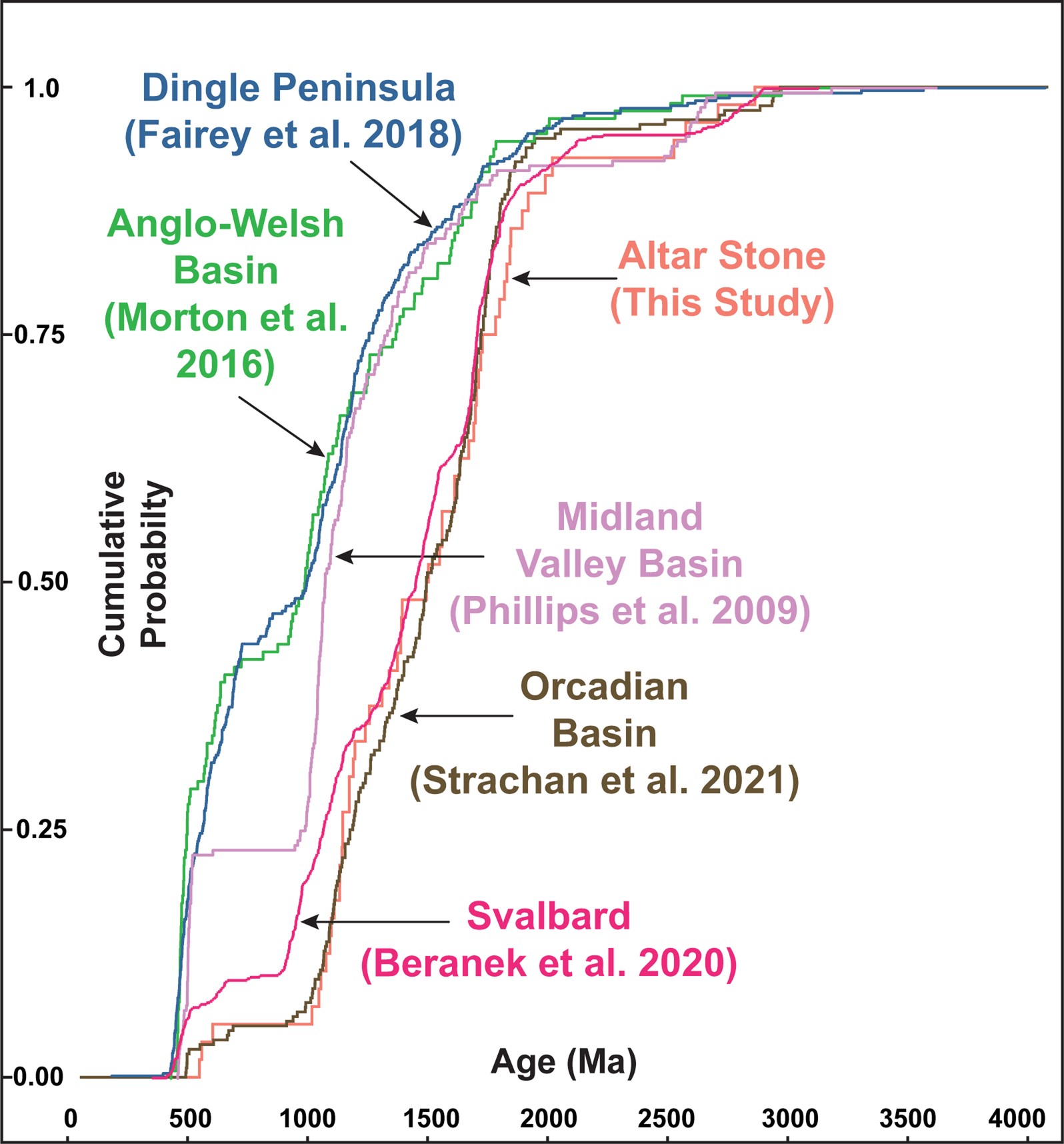
The result was at >95% certainty, no distinction in provenance can be made between the Altar Stone zircon age dataset (n = 56) and those from the Orcadian Basin (n = 212), Svalbard ORS (n = 619) and the Laurentian basement.
- Rutile U–Pb Results: From Altar Stone sample MS3 two groups were obtained. "Group 1 which constitutes 83 U–Pb rutile analyses, forming a well-defined mixing array on a Tera-Wasserburg plot between common and radiogenic Pb components. This array yields an upper intercept of 207 Pb/ 206 Pb i = 0.8563 ± 0.0014. The lower intercept implies an age of 451 ± 8 Ma implies an age of 451 ± 8 Ma
Group 2 comprises 9 grains, with 207 Pb corrected 238 U/206 Pb ages ranging from 591–1,724 Ma. Three grains from Group 2 define an age peak 68 at 1,607 Ma. Given the spread in U–Pb ages, we interpret these Proterozoic grains to represent detrital rutile derived from various sources."
## Significance:
- These matches support a provenance from the Orcadian Basin for the Altar Stone[2].
##Citations:
[1] https://pure.aber.ac.uk/ws/portalfiles/portal/50647128/linking_derived_debitage_to_the_stonehenge_altar_stone_using_portable_x_ray_fluorescence_analysis.pdf
[2] https://www.nature.com/articles/s41586-024-07652-1
[3] https://www.sciencealert.com/stonehenge-mystery-scientists-reveal-how-they-traced-the-altar-stone
[4] https://www.cnn.com/2024/08/14/science/stonehenge-altar-stone-scotland/index.html
[5] https://www.somersetlive.co.uk/news/history/stonehenge-altar-stone-stunning-twist-9485735
[6] https://www.cbsnews.com/news/stonehenge-altar-stone-came-from-scotland-not-wales-research/
[7] https://www.cambridge.org/core/journals/mineralogical-magazine/article/linking-derived-debitage-to-the-stonehenge-altar-stone-using-portable-xray-fluorescence-analysis/23E9A00C0C2B9FAC0BC74AC11AAE5B2D
[8] https://pure.aber.ac.uk/ws/portalfiles/portal/65608443/Assessing_the_authenticity_of_a_sample_taken_from_the_Altar_Stone_accepted_version_v2_Archaeologican_Science.pdf
[9] https://www.sciencedirect.com/science/article/abs/pii/S2352409X23001487
[10] https://phys.org/news/2024-08-stonehenge-giant-altar-stone-northeast.html
[11] https://www.cnn.com/2024/08/14/science/stonehenge-altar-stone-scotland/index.html
[12] https://www.academia.edu/81723766/Handheld_X_Ray_Fluorescence_Analysis_HH_XRF_a_non_destructive_tool_for_distinguishing_sandstones_in_historic_structures?uc-sb-sw=19875163
[13] https://www.snexplores.org/article/stonehenge-altar-stone-origin-chemistry-minerals
[14] https://www.nature.com/articles/s41586-024-07652-1
[15] https://data.jncc.gov.uk/data/d156c160-558d-4855-9927-6066e183045e/gcr-v31-old-red-sandstone-c2.pdf
[16] https://en.wikipedia.org/wiki/Orcadian_Basin
[17] https://nora.nerc.ac.uk/id/eprint/516767/1/CR16017.pdf
[18] https://www.ncbi.nlm.nih.gov/pmc/articles/PMC9230696/
[19] https://www.sciencedirect.com/science/article/pii/S0191814123001396
[20] https://pure.aber.ac.uk/ws/portalfiles/portal/65608443/Assessing_the_authenticity_of_a_sample_taken_from_the_Altar_Stone_accepted_version_v2_Archaeologican_Science.pdf
[21] https://static-content.springer.com/esm/art%3A10.1038%2Fs41586-024-07652-1/MediaObjects/41586_2024_7652_MOESM4_ESM.xlsx
[22] https://www.sarsen.org/2022/09/the-altar-stone-sample-provenance.html
[23] https://research.aber.ac.uk/files/38490241/Altar_Stone_Final_submitted_v6_4_June_1_1_.pdf
[24] https://www.academia.edu/5464937/Chips_off_the_old_block_The_debitage_Dilemma
(Lightly edited from originals kindly supplied - extra citations retained for further research)