Wednesday, 15 February 2023

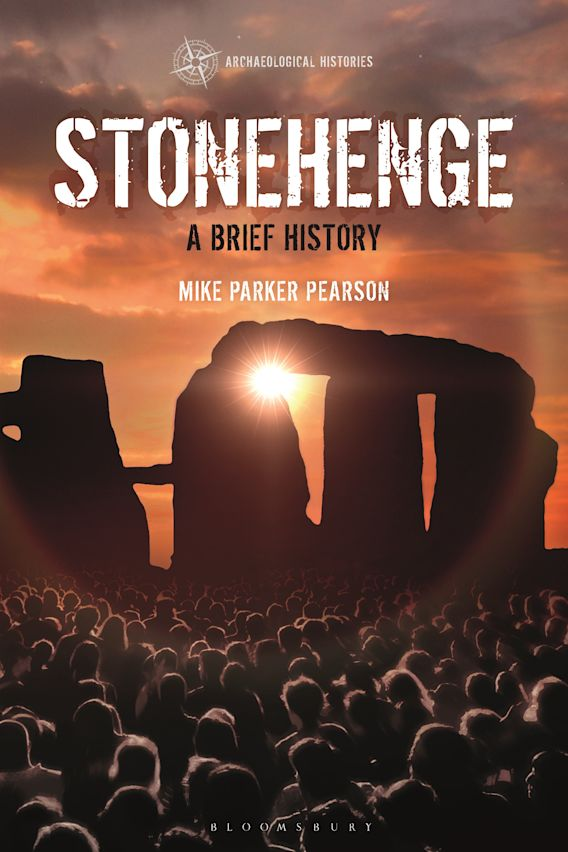
Stonehenge - A Brief History by Mike Parker Pearson

 http://dx.doi.org/10.5040/9781350192263 -  4 May 2023 release for dead tree versions, 6 April for electronic.


Stonehenge - A Brief History by Mike Parker Pearson


Book Summary / Abstract

Stonehenge is one of the world’s most famous monuments. Who built it, how and why are questions that have endured for at least 900 years, but modern methods of investigation are now able to offer up a completely new understanding of this iconic stone circle.

Stonehenge’s history straddles the transition from the Stone Age to the Bronze Age, though its story began long before it was built. Serving initially as a burial ground, it evolved over time into a sacred place for gathering, feasting and building, and was remodelled several times as different peoples arrived in the area along with new technologies and customs. In more recent centuries it has found itself the centre of excavations, political protests and even conspiracy theories, embedding itself in the consciousness of the modern world.

In this book Mike Parker Pearson draws on two decades of research, the results of recent excavations and cutting-edge scientific analyses to uncover many of the secrets that this prehistoric stone circle has kept for 5,000 years. In doing so, he paints the most comprehensive picture yet of the history of Stonehenge, from its origins up to the 21st century, and reveals how in some ways trying to explain its power of attraction in the present is harder than explaining its purpose in the ancient past.

Who built Stonehenge, how and why are questions that have baffled people for almost 1,000 years. Its secrets are now being revealed to provide a new understanding. Stonehenge’s construction sequence straddles the transition from the Stone Age to the Bronze Age, a time of momentous changes in society, technology and population. Long before it was built, Salisbury Plain was already a special place for people to gather. Some of its stones – the Welsh ‘bluestones’ – came from an already ancient ceremonial complex many miles away. Initially a burial ground, Stonehenge was later remodeled with huge sarsen stones at the same time that a large settlement was constructed nearby. People came to this sacred place from many miles away to gather, feast and build. After the arrival of people from continental Europe bringing knowledge of metallurgy and the wheel, Stonehenge was remodeled another two times. It was now a magnet for the illustrious dead, buried in hundreds of mounds around it, in their finery of gold and other precious substances. Stonehenge’s landscape was later converted into fields, leaving this great monument isolated and alone. Stonehenge eventually reestablished its popularity through the writings of medieval authors, early modern antiquarians and 20th-century archaeologists. Never free from controversy, it also attracted tourists, hippies, New Age travellers, pagans and druids. Interpreted as everything from an alien landing strip and a vortex of mystical energy to a cenotaph, a temple, a calendar, an astronomical observatory, a place of healing, a place of the dead and a monument of unification, Stonehenge has enthralled and perplexed.


Sunday, 5 February 2023

A Mesolithic Blade from Stonehenge Down from before the Stones

I was lucky enough to notice a flint blade excavated by a rabbit on Stonehenge Down when I wandered across to look at Dr. Philippe De Smedt of the University of Ghent,  Dr. Paul Garwood and Dr. Henry Chapman (both of the University of Birmingham) excavations in 2017.  


The rabbit hole shows up on Google Earth and so I could fix the find spot.


They were having the day off so I couldn't show them and so belatedly I have had it properly recorded.


PAS record number: WILT-6F2BBE
Object type: Debitage
Broad period: Mesolithic
County of discovery: Wiltshire
Stable url: https://finds.org.uk/database/artefacts/record/id/1084301


Claire Goodey illustration:  https://finds.org.uk/database/images/image/id/1212735/recordtype/artefacts


Rights Holder: Salisbury and South Wiltshire Museum
CC License: 


The excavation results have now been written up: -  Philippe De Smedt, Paul Garwood, Henry Chapman, Koen Deforce, Johan De Grave, Daan Hanssens, Dimitri Vandenberghe,

Novel insights into prehistoric land use at Stonehenge by combining electromagnetic and invasive methods with a semi-automated interpretation scheme,

Journal of Archaeological Science, Volume 143, 2022, 105557, ISSN 0305-4403,

https://doi.org/10.1016/j.jas.2022.105557.

(https://www.sciencedirect.com/science/article/pii/S0305440322000152)


Tuesday, 10 January 2023

The Avebury Papers

The Avebury Papers is a four-year Arts and Humanities Research Council funded project to develop, explore, and digitise the multimedia archive of Avebury’s Neolithic origins and its subsequent life-history. 

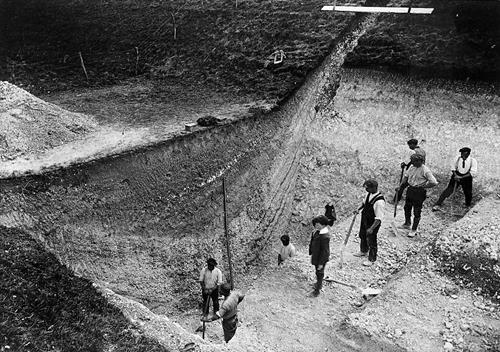
Photo - Wiltshire Museum -  close up view of ditch section during excavation of stone circle, Avebury, Wiltshire, 1911, an image from the Wiltshire Life Society collection


Currently dated to the first half of the 3rd millennium BCE, the megalithic monuments at Avebury, North Wiltshire, form part of the UNESCO Stonehenge and Avebury World Heritage Site. Avebury includes the world’s largest stone circle at almost 350 metres across, with avenues of paired standing stones that extend for 3.5 kilometres. 

 The only large-scale archaeological excavations to take place at Avebury were carried out just before the outbreak of WWII. Materials and objects collected and made at this time were left under-analysed for decades. As a result, we have – until now – only had a partial understanding of Avebury’s past and present. 

We will add to the archaeological work that ended so abruptly due to the war, bringing together findings from 1939 and subsequent excavations. The archive also includes creative work inspired by Avebury, and these stories are just as important as the stones for understanding Avebury today. Importantly, the entire archive will be made available online on an ‘open access’ basis for anyone to use for research, enjoyment, and artistic projects. xx By providing a fuller understanding of the history and modern significance of this World Heritage Site, this research and the creation of the multi-media digital archive will enable more effective heritage management, education, and tourism programmes. We look forward to visitors, enthusiasts and students of prehistory, artists, and heritage organisations, exploring the many stories of the origins and re-use of Avebury across over 5,000 years. 

The Avebury Papers is a collaboration between Bournemouth University, the University of York, the National Trust, and the Archaeology Data Service, with support from Historic England and English Heritage.

Sunday, 1 January 2023

6th January evidence a "Smoking Gun" or a damp squib?


"A STONEHENGE mystery has been solved, according to an expert, after a "smoking gun" discovery was made to provide the "missing piece" of the puzzle.

A giant bluestone erratic just discovered near Mumbles, on the south Gower coast, has been hailed as one of the most important glacial discoveries of the last century since it proves beyond doubt that the Irish Sea Glacier was capable of carrying large monoliths of dolerite rock from Pembrokeshire up the Bristol Channel towards Stonehenge."


First discovered and  photographed by Phil Holden on 5th January 2022, I believe the next day Dr Brian John was informed. Photos:


The photos' descriptions by Phil Holden state:"Hailed by (Dr) Brian (John) as the 'greatest glacial discovery this century'"

In an email of 2nd January 2023 Dr John writes: ""Hailed by Dr Brian John as the 'greatest glacial discovery this century'..." I have never made that ridiculous claim. Kindly withdraw that remark."   

I am happy to make clear I believe him that he never made that claim, I am merely reporting what others have written. A hint: words reported in quotation marks are attributed to the source not to the reporter. There are resources aimed at Lower Key Stage 2, Year 3, for those struggling with the concept.

And on his blog he writes "I have never claimed this as "the greatest glacial discovery of the century". I may be enthusiastic, but I am not that stupid,"

The Press Release on Dr John's blog: STONEHENGE: GIANT GLACIAL ERRATIC HAILED AS "MISSING PIECE” OF BLUESTONE PUZZLE  now has:  "hailed as one of the most important "chance discoveries" of recent times." 

But as reported in the press it originally said: (https://web.archive.org/web/20220127081903/https://brian-mountainman.blogspot.com/ "A giant bluestone erratic just discovered near Mumbles, on the south Gower coast, has been hailed as one of the most important glacial discoveries of the last century since it proves beyond doubt that the Irish Sea Glacier was capable of carrying large monoliths of dolerite rock from Pembrokeshire up the Bristol Channel towards Stonehenge."

It seems he has forgotten what was originally written, which seems close enough to the offending quote though to be fair it said "one of" rather than "the", and "important" rather than "greatest", and then it was later altered. If Dr John is not stupid enough to make that claim who wrote the Press Release? And why did he publicise it?

 After all that hailing, or not hailing, we might echo a sage and say:

"A year is a long time in academic geology. Looking back on it, it's actually quite intriguing to see how this piece of academic intrigue was instigated by somebody with an unshakeable belief that one theory (relating to human transport) was dead and buried, and that the only other theory in town (namely the bluestone glacial transport theory) must therefore be correct. He believed that all he had to do was find the evidence."

The existence of the erratic was announced in a press release 
This note was added later: 
"Phil's close-up photo of the sample taken from the erratic can be seen here: https://www.alamy.com/two-rock-samples-of-green-dolerite-with-thin-section-on-right-from-summit-of-foel-eryr-preseli-and-left-from-the-erratic-gower-boulder-eg-2hferaj-image455859195.html"

The photo is dated 6th January 2022

On 8th February 2022 Dr John wrote: "We have two samples from the boulder. We have been fortunate enough to receive sufficient financial support to pay for professional laboratory analyses, and the work is in hand. The results of the tests will be reported in a peer-reviewed journal in due course." (In the comments https://www.megalithic.co.uk/article.php?sid=56283 ) and a preliminary paper written:
https://www.researchgate.net/publication/358426131_A_newly_discovered_giant_erratic_at_Limeslade_Gower_Peninsula_Interim_Report
 
And since then silence.

Dr John kindly informs me:
I have no interest at all in withholding info about this boulder, and I don't actually care where it came from. The truth is perfectly simple -- we sent the Limeslade samples off for analysis to a geologist who -- for a variety of work and personal reasons -- has still not reported back to us, after almost 12 months. So in spite of many pleas, we still have no data. Rest assured that as soon as we get the info through, it WILL be published.

Is the "smoking gun" a damp squib?


Wednesday, 28 December 2022

Is this year’s tumultuous weather set to become the new ‘norm’ ?


The National Trust has warned that this year’s tumultuous weather is set to become the new ‘norm’ https://www.nationaltrust.org.uk/services/media/weather-and-wildlife-2022  The Stonehenge and Avebury WHS are thought to be at risk from climate change, so it is of interest here - http://www.stonehengeandaveburywhs.org/assets/Climate-Change-RA-for-web.pdf

We hear a lot about climate breakdown, that our climate is getting more unpredictable and tumultuous. We can survive and thrive in nearly any climate if we can plan and prepare for it from the arctic to the equator, from deserts to rainforests. But instability and uncertainty is dangerous. So is it getting more disorderly?

To check if any increasing instability was evident in England  I thought a simple, quick and dirty way would be to compare the annual, and each season’s, temperature and rainfall using the long running Hadley Centre Central England Temperature (HadCET) dataset https://www.metoffice.gov.uk/hadobs/hadcet/data/download.html  and HadUKP, the UK regional precipitation series available from https://www.metoffice.gov.uk/hadobs/index.html

My method was to compare the differences between years.

For instance the mean spring temperature in 2020 was 9.9°C, in 2021 8°C, and 2022 10.1° so the differences are  -1.9°C and 2.1°C.   I charted out the differences from 1963.

Wow, the swings are getting larger. English spring temperatures are getting less predictable.

So, I looked at more of the data.

Here’s the mean spring temperatures from 1904 – 1963:


Huh? That looks the same as the 1963 – 2022 chart.  Let’s overlay them to see:


So, spring temperature got more unpredictable from 1904 to 1963 and then the pattern repeated from 1964 to now.

What is going on? I don’t know but whatever it is it isn’t unprecedented.

 Just eyeballing the rest of the data graphs for the other seasons, years and annually I couldn’t spot any other repeating patterns either for temperature or rainfall. But torturing it with statistical analysis may reveal more. I hope someone with the skills does so.


  Another surprise to me from the series is how related the Min and Max series are. It appears that the temperature band is narrow, is it self-regulating?  A plot of spring temperatures shows: 


 A simple plot of Maximum temperature minus Minimum shows this over the whole period:


Sometimes very simple analysis is all that is needed to answer a question.

Friday, 23 December 2022

Mesolithic Machans

Yesterday the Mesolithic tree-throw and post holes were showing up well with grass mown and it reminded me to record my belief that there may have had been a practical purpose. 

If you are ever to try a spot of big game hunting, I haven't myself, I am assured that the Cape Buffalo is the most dangerous beast to hunt. I imagine Aurochsen were similar. They don't take kindly to being wounded and a couple of tonnes of beef behind some horns travelling at speed intent on revenge is best avoided. Using only spears and arrows kills would not have been quick and easy. 

Deer hunters in our local woods still use high seats, not so much to avoid the danger, as to be out of sight and smell of the prey and have a better view and platform to operate from. 

In India and south Asian countries, such platforms, in trees and where trees were absent on poles, are called "Machans". Thankfully they now more often used to photograph big game from than for shooting.

David Saunders* in his excellent studies on prehistoric cattle movements touches on the roles the posts may have played but doesn't, I think, suggest them as machans. So combining a sketch from E P Stepping's Diary of a Sportsman Naturalist in India and a photo of the post holes let me supply a suggestion of how the posts alongside a natural funnel for the beast may have been used.
*Saunders, David. The Cursus Enigma: Prehistoric Cattle and Cursus Alignments. Austria: NIELSEN BOOKDATA, 2021.